Day 10: Writing 101–Happy [special occasion]

Growing up holds the best and the worst of life–at least as viewed from a very young age.  The good memories from childhood may make any bad memories dim by comparison. I can’t remember a birthday or other celebration when my mother would make my favorite foods or desserts–that just wasn’t her way.  I doubt that she ever even thought about cooking that special dish just for me to mark a birthday or major accomplishment.  Although I knew that my friends’ mothers would cook their favorite foods on their birthdays, it never bothered me that my mother didn’t do that.  The main reason is that, to get my favorites, all I had to do was ask–no special occasion needed.  And my mother was an excellent cook who never used a recipe in her life.  Yet, she managed to make the simplest, plainest dish a celebration of flavor and aroma.  I don’t have her cooking talent, but my son seems to have inherited it.  He’s another one who can whip up a meal from whatever he finds in the pantry or refrigerator and create a feast of flavor that tickles the tongue.

But enough of the background, and back to special foods on special occasions.  Although my mother’s cooking and baking were kept simple, and despite the fact that no special meal marked a celebration such as my birthday, the one thing I always got on my birthday was a cake from a very particular Italian bakery that sat on the boundary between my town of New Brunswick (New Jersey) and Franklin Township.  I can no longer remember the name of the bakery, and know that it no longer exists, but their cakes were amazing creations of flavor, and the birthday cake fillings were miraculous.  My favorite filling was a peaches and custard that I can still taste, forty-five years after my last bite.  I always preferred the butter icing to the whipped cream icing, although both were good.  To get my birthday cakes, my mother would drive over a week or more ahead of time (sometimes certain fillings were not available unless someone asked for it in advance), and then drove back–usually after work–on my birthday to pick it up.  It didn’t matter if we celebrated alone (my father worked the second shift and took meals with us only on weekends), or if family or friends were present.  She always bought the cake that was large enough to serve at least 12 people, and that made my birthday last a few extra days.

My mother worked hard when I was growing up.  She and my father and I arrived from Europe in 1954, several years after post-World War II accords made it impossible for my parents to ever return to either’s birth land–my mother was a German born in Russia; my father’s family had a thriving farm in Belarus.  Both families were all but destroyed by the Communist wave that took everything from middle-class families.  What remained of my mother’s family managed to seek refuge in Minsk in Belarus, where relatives were supposed to be waiting for them to escape the west-moving force of Communism.  When my grandmother arrived with five of her thirteen children in tow, she found no relatives who had fled just before their arrival.  Stuck in Minsk, my mother’s family lived through the bombing of a beautiful city by both Allied and Axis nations.  My mother went to school as long as she was able at her mother’s insistence.  She was a star student, but was traumatized by the bombings and harsh realities of fighting forces in the streets of her city.  Despite going from middle-class status to abject poverty overnight, my grandmother insisted that my mother devote all her time to her school work, and never taught my mother how to cook or sew, although she did both herself because of that part of her “finishing school” education that all middle-class girls were expected to complete.  So my mother’s prowess in the kitchen was more amazing than if she had spent time watching her mother cook.

At some point after the war ended and “displaced persons” and families, caught in the midst of having no home, were basically interred in camps until the various governments could sort out which country would become their new home.  Most of the remains of my mother’s family were returned to Germany, as they were still considered German citizens despite their expat status in Russia.  My mother, however, met my father at whatever internment camp they  occupied–neither spoke much about the war or the years following armistice.  For whatever reason, they ended up in France, where I was eventually born, following the birth and death of twin brothers born too prematurely to survive back in the late 1940s.  I came along at the Epiphany in 1950 (my mother says I was born late and have been late ever since).  I don’t know if my mother learned to cook while in the camp, or received cooking guidance as a young wife.  My father, for some reason unknown to me–possibly because of his closeness to his mother who was all but killed before his eyes by Communist soldiers over possession of her chickens, and died shortly after–was a good cook in his own right.  Maybe be gave my mother suggestions or helped her cook from the beginning.  I’ll never know because my father passed away more than twenty years ago, and my mother turned inward after his death and speaks about nothing from her past any more.

When my parents arrived in the United States, my father was able to procure work quickly in one of New Jersey’s cable mills because he had been a steel worker in France.  My mother had picked up some hand-sewing skills while working for a seamstress in France, but hand sewing was not a sought-after skill in New Brunswick, and it took her a while to find a dress factory job that was willing to train her to use a sewing machine.  She became skilled enough that she was able to leave the poor-paying dress factory and get a job at the much better paying men’s suit factory.  After an initial training period, she was given the option of “time work” or “piecework.”  The opportunity for better earnings were in the piecework category, and my mother was nothing if not a driven and hard-working woman.  For years, she would take the bus to work but often walk the two miles home to save on bus fare.  So when she came home, she was already very tired.  When she learned to drive, because my father used the car for work, she would sometimes make arrangements with him to get a lift to his job so that she could run special errands.

My birthday cakes were always special errands.  Even after my sister was born almost twelve years after me, and she had made special arrangements to begin work early and come home to care for my sister before my father had to leave for work, on my birthday she would drop him off at his job, swing around and pick up my birthday cake, and made sure it was the evening’s dessert.

To this day, I know how difficult that was for her to do–especially when she had a demanding toddler to care for, too.  Just keeping my sister from getting her fingers into the cake on the drive home must have been what I call an interesting experience.  And yet she succeeded.  If my sister did manage to grab a bit of icing or one of the roses made of wafers from the top of the cake, my mother fixed it so that I would never notice.  I did, of course, but I never bothered to tell her so; she was always so proud of the way she covered up the tell-tale traces of my sister’s little misdeed.  But I knew there were always supposed to be three such roses on the top, not two; or that a section of the edging was a bit smoother than the rest.  It was probably the only thing my little sister ever did to me that I utterly forgave because my mother–already tired after an early start to her day and probably driven to distraction by the little tyrant–had tried so hard to bring home a perfect cake from a perfect bakery that was far from our house.


Posted in Writing 101 | 4 Comments

Day 9 Writing 101: Point of View

A man and a woman walk through the park together, holding hands. They pass an old woman sitting on a bench.  The old woman is knitting a small, red sweater.  The man begins to cry…

Melinda

Melinda stops dead in her tracks. Her hand clenches around Daniel’s. He doesn’t even feel my hand, she thinks to herself.  As his hand goes limp in hers, she loosens her grip gently and moves her hand away.  There is clearly something in his past that he hasn’t told me about.  Is it something so painful that he hasn’t been able to share it with me?  We’ve only been involved seriously for the past six months.  There’s a lot I don’t know about him yet. There’s a lot he doesn’t know about me, either.  Some of them are none of his business–ever!–and others we just haven’t gotten around to sharing.  Nothing we’ve talked about so far has given me any clue to why he would respond this way to seeing some old woman knitting.

Carefully, Melinda leads Daniel to a bench a little farther along the park path.  He sits blindly, staring straight ahead at a hedgerow of wild rose bushes that block whatever scene is behind it.  He wouldn’t see anything even if the hedge weren’t there, thinks Melinda, as Daniel’s sobs wrack his body.  How could anyone see through the storm of tears falling from his eyes like a waterfall?  She puts her arms around him and pulls him toward her, afraid to say a word, but wanting to comfort him from whatever demons are playing with his memories.

Diana, The Old Woman

Oh, the poor man! thinks Diana, knitting the Christmas sweater for her newest great-grandson without even looking at her work.  Years of practice let her count stitches in her head as the working needle picks up the next stitch from the other needle.  She comes here to knit because it’s quiet, and she loves to be among the greenery.  Such a difference from the stuffy old apartment that she can barely stand to be in since Charlie passed away two months ago.  She watches the young man thoughtfully as his young lady sits him down on the next bench down the path.  He must have just received some horrible news.  I wonder if his young lady has just told him she wants to break up, or that she has some dreadful disease.  Or that she’s pregnant.  Maybe he’s stepping out on a wife and doesn’t know how he’ll handle this.  Well, I imagine he’ll adjust or figure out what to do.  Poor man, sobbing like a child who just lost his mother at the mall

Daniel

Oh my God oh my God oh my God… Where did that memory come from?  God, I miss her.  She was the only person I ever knew who understood me so well–better than I did myself, and better than my parents who had seven other kids to worry about.  I was the youngest, and an surprise birth at that.  My oldest sister was twenty-two and had just given birth two days earlier.   Granny had been knitting a Christmas sweater for my new little niece when the heart attack took her.  The sweater was red, just like the one the old woman is knitting.  And it was as tiny and cheerful. Another sob wracked his body, even though the tears had slowed to a few drops.  He felt safe with Melinda’s arms around him.  What must Melinda think of this crying jag that came out of the blue like that?  But she’s not asking any questions.  She’s waiting for me to explain.  She probably thinks I’m crazy, and will think twice  about accepting the ring I have for her in my pocket.

The convulsions that wracked his body as he cried have stopped altogether, replaced by a few hiccups.  He stares at the wild roses, just beginning to open their buds in the late spring.  They will bloom only once this year, he thinks to himself.  That’s their way–one glorious display of pink-tinged white that will fall like snow after a few days, and begin to turn brown the moment they drop, completing the color change within two days.  A groundskeeper will rake them up and cart them to the ever-present mulch pile in the part of the park no one is supposed to ever see.  Eventually, all that mulch will become part of the fertilizer for the domesticated shrubs and the perennials that pop up all over the rockery and formal gardens elsewhere in the park.

With a final sigh, Daniel slides his arm around Melinda.  “Thank you for being here for me, he begins.  “I’d like to explain…”

#writing101

Posted in Fixing Education | Tagged , | 4 Comments

Speak Up News – April 2015

Here’s something interesting for adults and kids alike. Teachers, what do you think?

Michael K. Barbour's avatarVirtual School Meanderings

Also from Monday’s inbox…

Like  Tweet  Pin  +1
SUbanner

Speak Up News – April 2015

Happy April! We are excited to release our Speak Up 2014 student data at our first Congressional Briefing later this month! Keep reading for more information on how you can RSVP for the event in Washington, D.C., request a copy of the report, and watch our video live stream of the event, as well as additional webinar and education technology opportunities that are taking place this month.

Quick links:

National Release of Speak Up 2014 National Findings: Learn more about our first Congressional Briefing and how you can RSVP to this event.

Can’t make it to our first Congressional Briefing? RSVP for our live stream of the event and request a copy of the report.

Speak Up Data Luncheon at ISTE 2015: Learn how to use your Speak…

View original post 1,242 more words

Posted in Fixing Education | Leave a comment

Day 7 of Writing 101: The Meaning of Artistic Media

Drawing and Writing are hotly debating their differences at the local Starbucks. Drawing brought her iPad, with its various art apps, and her electronic pen; Writing has his Surface Pro before him, with its magical keyboard.  Each device shows an interpretation of “the meaning in/of art”–a rough sketch on the iPad, a first draft of a short story outline on the Surface.

“You can just see the beginnings of what I’m trying to say about art in this montage,” says Drawing.  “I’m still working on fitting all the pieces together into a cohesive whole…”

Writing looks across the table at the sketch. Clearly, it is an early plan, just as his story is a sketchy list of ideas, not quite organized, not quite complete. “I’m beginning to think it’s easier to express the meaning of the art of writing than to express what art means through your visual arts.”

Drawing sighs.  “Look, we’re never going to come to a complete agreement here. Personally, I really suck at putting words to paper.  And we both know that your stick figures are not exactly a high form of any visual media I know of, except maybe cartoons…but even so, we’ve challenged each other to express this idea in our own art forms, and I’m finding it harder to organize my visuals than usual.”

Writing nods. “I’m having trouble with organizing my ideas, too. Heck, I’m a writer of short stories, which is a world apart from nonfiction.”  He looks down at the annotated outline.  Hmm, he thinks.  This is a temporary sketch of a final product, and I hate writing nonfiction–one has to be able to support every concept, or at least be able to clearly state what that concept means.  “Maybe I’m just not good enough to write an expository piece.”

“Meaning…?” asks Drawing.

“Any idea how hard it is to express boring facts in an entertaining style?” he complains.  “Oh, sure, I’ve read a few articles written in wonderful prose, but most others are so pedantic that I can’t even get through the first few paragraphs.  So what makes me think I can philosophize on the art of writing in an artistic and creative way that actually gives meaning to written works?”

“Can you pretend you’re writing fiction? Can you go back to any of those well-written pieces you mentioned to see how they did it, how they held your attention?”

Writing says nothing for a moment.  “My fiction writes itself,” he admits.  “I start with a topic and let the story write itself, which usually means that the story veers off the plan I had in mind. That’s my style. For this type of piece, I need an actual plan that I have to stick to.”  Again he is silent for a moment.  “To be truthful, I’m not sure I know what the art of writing actually means.”

Drawing looks down at the blobs on her iPad that she’s labeled with words like “love,” “hate,” “politics,” “rebellion,” and a few other conceptual representations she hopes to keep in her montage.  She sighs again.  “I’m finding it hard myself.  Usually, I have a single emotion or concept that I want to express in shapes and colors–or maybe a scene I am observing gives me an idea.”  She looks up at Writing.  “Hell! Most of the time all I’m doing is representing what’s in front of my eyes or in my imagination.  If emotion or meaning gets in there, it’s by pure accident–kind of like my subconscious mind asserting itself through my medium.  Forcing ideas onto a canvas–and before you say it, yes, I consider the iPad as much of a canvas as the linen stuff I paint on!–it’s not easy for me to do.  I’ll really have to think on this and decide how much of ‘meaning’ I want to–or even can–represent.  Sometimes I wish I had just taken up photography…but I’m no photojournalist either, and I don’t have an eye for what photographic scene will inspire others, much less express some sort of meaning.”

Writing chuckles.  “I read you loud and clear.  Remember all the great prize-winning photographs from Life Magazine, or some of the great war-related photos published in the Times?  One picture that really does represent a thousand words…”

Drawing smiles as she looks down at her iPad.  She is thinking about some of those photos from Life, and the photo essays from National Geographic, and all the other sources that told stories through pictures. She opens Safari and starts searching for thematic photos in the National Geographic archives…

Writing has minimized his story draft and is searching through the Life web site for the short expositions that always accompanied the photos…

#writing101

Posted in Fixing Education | Tagged | 12 Comments

Will the Real Alice Please Stand Up?

Sometimes you learn a lot of interesting things about people whom you have met in passing previously, but for one reason or another have never fully engaged in conversation.  The conversation is when you get to know people—the topic of original conversation, the turns and twists taken along the way that take you to an altogether different place.  And you find yourself learning quite a bit about both the other person and yourself.

There are also people with whom you have conversed many times and at first found fascinating, only to realize after several weeks or months that they really have only one major topic—usually themselves.  Or you get to a point where topics become less neutral or friendly and more critical or dour.  By the time you realize that more time is spent in the negative hemisphere than the positive, you start wondering what it was you found so interesting about the individual to begin with.

So meeting a person for the first time does not necessarily occur in a single moment in time.  It can take place over many months.

It took me a while to realize that an individual I met two years ago—let us call her Alice, for the sake of privacy—is nothing like the friendly, open, and nice person I thought she was for most of that time period.  In fact, the last four or five encounters I’ve had with Alice have been rather uncomfortable and, during the most recent instance, clearly dismissive.  But allow me to tell you how she was before I explain recent observations.

Alice has a very high position in a local learning institution.  Part of her job involves a great deal of PR work with the overall community.  And she is the only person of the school that does so, giving her quite a bit of clout. When I first met her, she seemed to be a Child of the Sixties, which included being the “groupie” for her husband’s performances, smiling at everyone, speaking briefly to all faculty and spouses, and ostensibly getting to know the driving forces of the island. When I first met Alice, she had been here only a month or so longer than we were, and seemed to be thoroughly enjoying life in the Caribbean.

The faculty, administrators, and staff combined is a small enough population that all employees pretty much have at least a nodding acquaintance with every other employee.  The faculty have a weekly Friday “blowout” to let down their hair and just get to know each other as human beings.  Spouses, visitors, significant others, etc., are always welcome.  General staff rarely attends, probably because some of the conversations can become very technical and are over the heads of even the spouses and visitors.  Some administrators stay away because–well, they probably think much of the conversation revolves around their capabilities; interestingly, no one discusses the administrators unless it’s to speculate on their health and/or their long vacation from the island.

From my first such outing, I found it difficult to carry on a conversation with Alice. Granted, I’m no brilliant conversationalist, but I’m a good question-asker, getting people I meet to open up a little about themselves and learning what brought them to the island, what they had been doing before, what their hobbies were and whether the island provided enough environment to pursue those hobbies, etc. etc. etc.  You know: the general types of questions people ask of others just because–small talk, I guess; or maybe to figure out if this person has the potential to be a friend or characteristics that leave them in that nebulous no-man’s land of acquaintance.  At first, speaking to Alice was like talking to a chair.  Very little of my usual “getting to know you” questions were actually answered, and I could barely get her talking at all unless she had a couple of drinks first.   You know how it is.  Sometimes there are people who never pick up their side of a conversation, no matter how hard you try to get them talking about anything.  However, after a while, Alice became generous in her exchanges with me, although clearly she would remain an acquaintance.

Over the past several months, I felt that she was going out of her way to avoid me (so, of course, I made it a point to “visit” with her long enough to say hello, glad you’re here—that sort of thing–just in case I was misinterpreting).  But even at campus social events, it became clear that she had little to say to me, and once actually grabbed her husband and another couple to sit at a different table during a special formal function.  Being me, I confronted her about whether I had done anything to offend her, and she answered no—but I had some trouble believing her, since she became even more adept at avoiding me from that point on.

Now I began seeing myself as meeting the real Alice for the first time.  I feel that the original Alice was a phony, and I’m not even certain that the new one is any more genuine in general.  A dinner at a faculty member’s home on Easter clinched my perspective–at least for now.  I try not to attach motive to the actions of people I observe, but sometimes… Well, I was having a pleasant conversation with one of our hosts’ guests.  We both had a mutual friend who had left the school, and there had been a bit of friction between me and that friend that caused us to steer away from each other for a while.  Eventually, we made up.  So I filled the guest in on this upward progress, and wondered if she had heard from the mutual friend more extensively than I had recently. As it turned out, I had more contact than she had.

But to bring Alice back into the conversation: the guest and I were  having a lovely conversation about this and that when Alice interrupted, sitting on a small circular coffee table that could have served as a stool, deliberately turned her back to me, and began a conversation with the guest without an acknowledgement that I was there, or even an apology for interrupting the discussion.  Guest and I were tete a tete, so there was no reason to think that we were merely sitting back and enjoying the ambiance.  This was not an inadvertent interruption. This was a deliberate intrusion.  I sat back and watched in absolute astonishment as Alice kept right on talking and making certain that I could not became part of the new conversation. For a few moments, I sat there as Guest tried to bring me in.  Each time Guest did that, Alice would move her hips over as though pushing closed a door that was not swinging shut fast enough on its own.

I guess I should have been expecting this for some time, but I just found the entire event highly rude and so dismissive of my presence that the only thing I could do was stare and smile, bitterly laughing inside that Alice had finally played her trump card.  During a pause, I excused myself from the sitting arrangement, telling Guest that we could continue our conversation later, and telling Alice it was nice talking to her.  Guest looked like she wasn’t happy about what just happened; Alice didn’t even seem to hear the part of the comment directed to her.

As I said, looking at the character of someone “new” does not mean it has to be a person you recently met, per the assignment.  It could easily be meeting the new person inside an old acquaintance.  I don’t know if I have ever met the real Alice, or if the Easter Alice is the genuine article. Alice’s action just surprised me greatly, won’t be going out of my way to just say “hello” at the next gathering I attend. If this behavior continues, then so be it.  She is not worth any further angst.  And, although I’m always free to change my mind, right now I don’t like Alice very much.

#writing1o1

Posted in Fixing Education | Tagged | 2 Comments

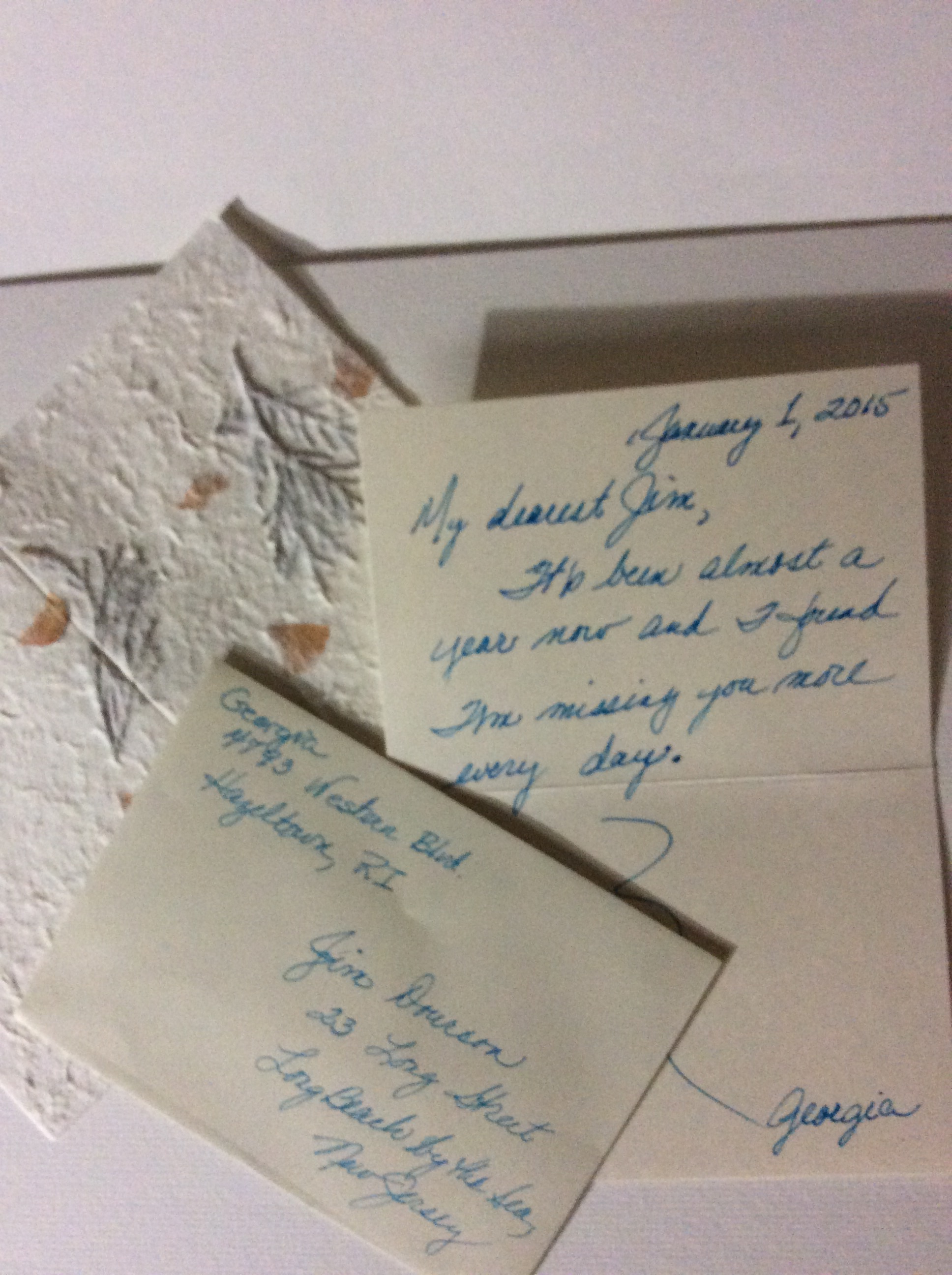
The Letter — Writing 101 Assignment 5

IMG_0048

The gust of wind died as suddenly as it began.  Something leaned on my sneaker–a letter.  I picked it up.  No stamp.  Address and return long distances from my town.  Opening it carefully, I learned it had been written months ago–just this past New Year’s day.  A single sentence:  Georgia missed Jim terribly.  A curved line flowed from the fold to the signature.  I sensed an urgency to the unreceived words.  Maybe Georgia had moved and the letter fluttered from an open box?  A move? A sudden illness? Worse?  I could not tell.

I took the letter home, carefully resealed the envelope, attached a stamp, and walked the missive to the letter drop inside the local post office.

It is for Jim to discover Georgia’s meaning…

Posted in Fixing Education | Tagged | 11 Comments

Serially Lost: Part 1 of 3–Writing 101 Assignment 4

Today’s Writing 101 assignment is to write about loss, with a “twist” of making it the first of a series of three pieces.  The only requirement of the loss is that it was once part of my life but is no longer so.  After thinking long and hard on the topic and its possibilities, I’ve decided to let the assignment decide, as I write, whether it will be serial–that is, a continuing story that perhaps deals with a single loss in three different ways or is merely presented in three continuing posts–or a trilogy of three separate losses.  What I know at this moment is that all three stories will deal with the loss of a family member.  Today’s story will set the stage for touching on one meaning of loss as well as defining one type of family.

Where this story starts is with my most recent loss–two, actually; two that occurred roughly two months apart.  There is a similarity in the two losses that make them one, despite the differences surrounding each individual loss.  This first Loss revolves around the death of two young cats–only five years old–that had been family members since kittenhood.  The younger cat, Shadow, was adopted first, at the age of two months.  One month later, the elder cat, Stan Lee, was adopted at age four months.  In essence, they spent the majority of their kittenhood together as best buds, but their character differences–and perhaps their genders–took them in somewhat separate directions at about the age of one year.  They remained friends to the end, but seemed never as close as they had been while kittens.

Although they were clearly separated in age by only one month, my mind maintained a difference of two months between them.  Effectively, although they both were lost to us within two months of each other, in my mind they died at the same age.  The mind sometimes refuses to accept the facts laid before it, and the true age difference was one of the very few “realities” from which my mind rebelled.  But none of this is important to the story, except that in my mind, they died two months apart at the same age.

Near the end of September, 2014, while I myself was recovering from a severe illness that required the transfusion of 6 units of blood, I realized that Shadow was completely listless, and it was unclear whether she was eating enough, since Stan generally ate his fill first but always left plenty of food for her.  All I noticed was that the cat food bowl didn’t seem to require filling as frequently.  At the same time, the dog, Rincey (who was adopted a year after Shadow), started to become uncharacteristically protective of her.  Two nights after I returned from the second hospital stay in less than two weeks, I became extremely concerned over Shadow’s lethargy.  This normally active and rather assertive kitty simply would not move, no matter how much Rincey kept coaxing her to bed.  My husband felt there was no difference in her activity level, but I was insistent that we call the emergency veterinarian.  At midnight, with me driving despite orders not to do so for at least a week (my husband does not drive), I packed Shadow up in her carrying case and knew for certain something was wrong when she didn’t resist.  Joe held the carrier as I drove slowly along the familiar yet very dark and gratefully empty roads to the veterinary office (tourists were either in one of the many night clubs or taking advantage or resort activities).  This was not the doctor we normally used, but it was the only one available for 24-hour emergency services.  In the dark, and along our crazy island road system, it took me almost half an hour to drive the 5 miles or so.  The veterinarian, whom I had woken with my call, immediately saw that there was a problem, ran a few simple tests, and asked that Shadow remain in the clinic for further testing and observation for a few days.  Her blood sugar was down, she was dehydrated, and there was every indication that Shadow was suffering from pancreatitis.

I called about Shadow’s condition the next day and was told she was stable, but that they wanted to keep her for a week.  I was welcome to come and visit her on Monday (two days hence) during regular operating hours.  After I visited, however, Shadow–already traumatized by the barking of the hospitalized or boarding dogs–went into a decline, and it was agreed that I should not visit again until she was ready to come home.  In the meanwhile, she would be moved into the doctor’s office in a different part of the building where she would have some respite from the clamor.  She was refusing food, but was drinking some water.  It was the lack of food intake that bothered the vet.  After a few days, the doctor discovered that Shadow would take some food if hand-fed.  Shadow remained in the hospital for ten days, and was sent home with a special low-fat diet for diabetic cats.  Once home, her appetite and activity level recovered for about three days, and then the lethargy and food refusal started all over again.

Back to the vet clinic for a few days.  I dropped her off and continued to my favorite grocery store for some badly needed provisions.  When I got home, I unloaded as much as I could carry myself from the car, and left the heavier items for my husband to take care of after work.  I’ve had three surgeries on my lower back and, between the recent illness and general effects of the surgeries, heavier items need to be unloaded by my husband.  I went to bed earlier and had assumed my husband let Stan in after emptying the car late that night, after walking the dog and before coming to bed.

In the morning, when Stan wasn’t rubbing against my ankles as my coffee was brewing, I got worried and asked Joe if he had seen the cat.  Joe thought he let Stan out before taking his shower, so I didn’t worry–until Stan didn’t come in for his afternoon nap.  Never before had Stan not come in at night.  Even when he was “late,” he yeowled to be let in, waking the neighbors with his racket.  When he was on one of his late nights, I generally waited up for him so the neighbors’ sleep was not interrupted.  I called Joe at work in the afternoon, and he swore he had let Stan out before I got up.  Five minutes later, he called back because he no longer could remember if he meant that morning or the day before.

My husband has trouble seeing–in general, but especially at night.  During the dog’s last walk, he always dons one of those head flashlights that spelunkers often use to see where they are going in dark caves.  He was still using it when he unpacked the car the night before.  Another problem Joe has is poor peripheral vision.  As for memory–well, we all get forgetful as we get older.  And between my recent health issues and Shadow’s, and his work load being a lot heavier than usual because he was preparing to present a paper at a conference on a neighboring island, he wasn’t paying much attention to anything other than unloading the car.  His memory loss included me telling him that Stan had developed a new habit since we began taking Shadow on trips to the vet clinic–he would jump into the car at every chance he got.  Luckily, I wasn’t driving much, and I was always aware of Stan’s whereabouts when I was using the car because he always ran out of his daytime hiding places to welcome me home, even if he didn’t come in with me right away.  But Joe’s fatigue had gotten the better of him, and he was having trouble remembering what day it was, much less whatever news I had to impart about the pets and household concerns.

Well, we live in the tropics on the island of St. Martin in the Caribbean Sea, and even in the dead of winter, cars get very hot during the day.  Everyone keeps their windows shut because of the frequent and unexpected rainfall, and I had no reason to drive the next day.  When Stan didn’t come in that night, I thought he had either been badly beaten up by one of the few nasty feral cats in the neighborhood (most are super friendly to both people and other cats).  Joe and I had taken turns for several hours searching outdoors and calling his name.  The next day, one of Joe’s co-workers told him there had been a cat run over on the road near our complex (we live very close to Joe’s workplace because he doesn’t drive), and we made the assumption that it was Stan, although the remains had been driven over so many times that it was hard to tell if it was even the body of a cat, much less what color it was.  Since I had an appointment, I had to use the car.  First, I took one final walk around the complex, calling for Stan and receiving no response.  Then I opened the car, and the odor of cat really hit me.  It was far too strong to have been from Shadow’s fear as we transported her to the clinic.  It took a few minutes to realize that Stan had climbed under the front passenger seat in an attempt to avoid the heat of the sun.

I couldn’t blame Joe–Stan was “classified” as his cat while Shadow was “mine.”  Joe has enough issues and loved that cat too much for me to be upset with him.  He couldn’t blame me, because I had asked him to empty the car while there was still daylight, and I was only using the car for visits to the doctor and the veterinary clinic at that point.  It was simply a tragic accident.  We mourned Stan’s loss, but it made it even more important to both of us that Shadow got well.  Meanwhile, Shadow was still at the clinic, and we had to take a three-day trip to St. Kitt’s for the conference.  When we returned, my doctor immediately hospitalized me again.  I had barely received the Shadow report from the clinic when I was sitting in front of the doctor’s desk listening to the results of my latest blood count tests as she was also calling for an ambulance to get me to the emergency room yesterday.  The doctor had allowed the St. Kitt’s trip because she wasn’t expecting the severe anemia that showed up on the tests.  Shadow was showing some progress again, but the vet was willing to keep her until I was home from the hospital.  The following week, before I was technically allowed to drive, we brought a reasonably healthy Shadow home again.  She immediately noticed Stan’s absence, and her behavior went into an immediate decline.   Instead of an active and hungry cat for three days, the lethargy set in almost immediately.  We were hand-feeding her, forcing water into her with a medicine syringe, and she began hiding in places that we had a lot of difficulty finding.  Meanwhile, I was making plans to fly to the Mayo Clinic in Florida because the news about my health at our local hospital made it clear that I could die at any time if I didn’t have surgery.  Our local hospital would  (almost) make an African field hospital look like the most modern facility in the world.  Shadow was in the clinic, and Rincey was taken to his doggie day care center for boarding.  And we flew out from the island for a few weeks.

The news I received at Mayo was great, and has put serious doubts in our minds about hospital medical care providers on the island.  They are fine for emergencies, but you wouldn’t want to have much more than the transfusions and minimal testing I underwent there.  We came home Christmas Eve and had to wait several days to retrieve the pets.  We left Rincey in boarding for a few days longer than necessary so that Shadow could have our undivided attention for a few days.  We had her home for just over a week, and I was forced to take her back to the clinic on my birthday in early January.  They were trying out different insulin combinations to see which she would best respond to.  I didn’t go visit because she had taken such a downturn the first time we took her in, and the vet agreed that we should just stay away until it was time to bring her home.  Eight days later, I received a call from the chief veterinarian suggesting that we seriously consider ending her suffering, as she was not responding to any of the insulin combinations they tried.  I asked that they do nothing drastic until we could come in and say our good-byes.  Joe was clearing his work calendar as much as he could so that we could go as soon as possible.  He thought he could be home in three hours.  Four hours later, I called to remind him that we had to see Shadow.  That’s when he told me that the vet called him two hours earlier to tell him she had passed away on her own.  Joe was too broken up to call me with this news, and threw himself into some more work, then lost track of time.  I was not shocked by the morning call, and not by Joe’s response.  I had been preparing myself for Shadow’s loss long before we lost Stan.  She died almost two months to the day of Stan’s horrible accident.  I am convinced that this little fighter simply gave up when she couldn’t find her old buddy.

That evening, before the veterinary clinic closed, we drove out to say good-bye to Shadow. It’s really, really hard to drive with tears streaming down one’s face.  Shadow had apparently crawled into the lap of one of the doctors who was trying to feed her by hand and fell asleep.  After a few minutes, the doctor noticed she wasn’t breathing.  She had moved silently and painlessly (we hope) into the next world, in a quite different manner than her best buddy had gone.  But we had lost two relatively young cats in a very short span of time, and–although we had made the decision not to replace our pets as they passed because any new ones might outlive us–we asked if they could keep an eye out for any kittens who were brought in for adoption.  The vet paused, and told us that she had been euthanizing kittens all afternoon, as the island is really not large enough to sustain too many cats.  The catch, neuter, and release program is a big deal on the island, as the feral cats are very friendly and, apparently, hotly passionate.  Found kittens are kept for three days; if not adopted, they are put to sleep.  But this one kitten…although she would have to be put down as soon as the office closed, there was something about this one that put her at the end of the line.  It was her beautiful eyes.  Would we care to see her?

We have a new member of the family.  Her name is Esme.  Within one week, she and Rincey became the best of friends.  She is sweet, assertive, fearless to a fault, more adventurous than our last several cats, was clearly raised–at least partially–indoors, but lives for being outside.  She is now four and a half months old, and wrestles with Rincey, who is close to 20 pounds and extremely gentle with her and tolerant of her rough play.  She runs at him and jumps on him like a lioness attacking a zebra–frontal attack with teeth aimed directly at his neck.  Good thing he has a very thick coat, or the claws and teeth would have made them mortal enemies instead of friends.  They sleep near each other, wake each other up to play, and peacefully share the communal water bowl.  All is well between them unless Esme tries to eat Rincey’s food.  Rincey still doesn’t understand about cats, and can’t figure out why she won’t return the balls he rolls to her.  Otherwise, they get along splendidly.  And we have balance in the family again–two males, two females.  We still miss the other two cats, and often call Esme either Stan Lee or Shadow.  But…

In my mind, Shadow became the salvation of our new family member, Esme, the kitten with a tear-drop marking at the corner of her left eye.  The beautiful eyes…

Posted in Blogging U, On Loss, Writing 101 | Tagged | 7 Comments

Writing 101: Day 3 … a day late #writing101

When I received the email message for this assignment (Write about the three most important songs in your life — what do they mean to you?), I stared at it and felt more ancient than I ever had in my 65 years. Why? Because there must be close to 1,000 songs–actual songs, concert pieces, instrumentals–in several genres (classical, rock, R&B, experimental) that I love, each bringing to intellect and emotion memories that are etched as indelibly on my soul as my own name.  Almost all music is important to me, and many pieces flood my being with multiple echos of relationships, places, individuals who have passed through my life… For the first time in a long time, I could not even begin to conceive how to start, where to start, when to start, and what to express.

As for the twist (You’ll commit to a writing practice)… well, I actually do that already: whether writing a blog post or writing in my “traditional” hand-written journal, I already write for at least 15 uninterrupted minutes each day.  I should modify that a bit: there are rarely such long moments when I am not reassuring a dog, removing a persistent cat from my keyboard, my husband entering a room talking, or just the normal distractability of my ADD (yes, you can have ADD until you die of old age!).

Right now, as I sit here trying to type in a stream-of-consciousness sort of way, I am also thinking about getting my car over to the inspection station since I am already almost 2 months overdue (thankfully, the authorities of my island home are more concerned that I have the appropriate plates on my car, indicating that car taxes have been paid, than if my car is safe to drive), the suggestions and instructions given by my drawing instructor during yesterday’s session, trying to figure out where I have previously met the artist who appeared in her studio who said we already knew each other, trying to remember to call my oldest friend (in terms of friendship length, not age) and how to dial the US from this God-forsaken island, trying to figure out what I omitted or added to my pot roast last night that made it less good than usual, etc.  Even as I express these thoughts, I keep coming back to the fact that so much music is important to me that I cannot possibly choose any three, even by random selection processes and explain their meaning to my life–especially since there are many songs whose lyrics I used to know by heart and have just now vanished from memory and consciousness.

But the assignment is to select three songs, so I will try to select three than have had some sort of an effect on me, even if I cannot remember the words, the performer/composer, or even the title of the piece.  And I’ll start with a Shostakovich suite in some minor key that has taken me over the years from comfortable listening in the first movement, to strife and anguish in the second, and, in the third movement, the resolution that I know where I am going and how strong I am.

For the second, I cannot include a single song, but I can select a group–The Four Seasons–who always, always call to mind my first (and perhaps only) love.  I broke up with him during college, mostly because I was scared to death that I was unworthy of him, no matter what lame excuse I gave at the time.  It doesn’t matter now, and–in retrospect–the breakup was definitely in his best interest, as he was quickly picked up on the rebound by a woman who was waiting for a chance to pounce on him the minute I broke his heart.  To be honest, I liked her very much both before I met her and when I finally met her at a high school reunion.  When I first learned that they had connected, I felt very sorry for myself, but honestly honestly honestly was incredibly happy for him. So which Four Seasons song?  All of them.  We were both, he and I, great fans, and every Four Seasons or Frankie Valli song that comes on the radio reminds me of him and brings back fond memories–as well as heartache and questions like “what if…?”

Frank Sinatra’s “It Was a Very Good Year” and all the other songs he sang that reference aging and growth of wisdom become my third choice.  He makes me recognize the progress I’ve made over the years in the way I look at the world, in my acceptance of the variants of cultures as learned from the various representatives of those cultures, the way I can accept the nuances of cultural mores that differ from the one I was brought up in.  And his songs remind me that in many ways there has been no change in me at all.  I still become angry over injustices of any kind, I still cannot understand the tenets of very “traditional” Christians who speak of Jesus’ teachings yet fail to see that they act in ways or live their lives in direct contradiction of those teachings–not all Christians, just far too many for me to understand just how clearly they understand those Bible passages they so passionately discuss while failing to see their own hypocrisies.  I do not paint all Christians with the same brush, nor all Muslims, Jews, Hindus, Budists, atheists, agnostics, Wiccans, or any other religious belief out there.  I understand good people trying to live a good life–for real, not for show–and I have gained the wisdom to know the difference between “not a very nice person” and “a truly good person.” I did not mean to get into religious philosophy or belief systems here, and I apologize for including this as part of the stream of consciousness writing.  I myself am completely enigmatic, and have few people in my life that I truly believe are “friend.”  It’s not that I have enemies–or not many, anyway; it’s that I find that people who get to know me tend to have only one of two opinions:  1) What a bitch; or 2) Hey, Girlfriend!  No one is ambiguous about me, and that’s OK.  Because I have grown into an age when, although I still lack social self-confidence and continue to be self-critical about everything new I attempt, I am a far better person today than I was fifty years ago when I thought I knew it all.  Like Sinatra, I’ve learned that I know nothing and that I must continue learning with an open mind.

A note of clarification: during the writing, I did go back and correct spelling and other things. None of the words were changed, although once I rearranged the words to make somewhat better sense.  This is not because I am a perfectionist, but rather before these little activities give me think time to work out how to express the next concept in my mind. For those people to whom words come easily–whether or not actual writing does–such activity would be a distraction from stream of consciousness.  But I do not have the facility with words that most writers have–and perhaps should have–and so I correct while my mind finds words (any words) to continue on.  So if I have a verbal weakness, why do I write?  Because each time I write, I get just a fraction of a bit more adept at putting words together–those words that in some way begin to describe the concept or  picture in my mind’s eye.  Even after–what–55+ years of practice, I have phenomenal problems with words.  When I speak, it is very difficult for me to express my ideas logically.  I often resort to analogy or metaphor, which are almost as hard for me, in order to make myself understood.  When I ask, “Does that make sense? Did I give you an idea of what I mean?”, I never know whether the nods and yeses or positive-like murmurs are genuine.  So I generally ask questions rather than speak.  When I do speak clearly, it is about a subject that is so passionately dear to my heart that I gush words that somehow bring on complex ideas.  Most people back away when I get like this; but a few people “get it” for real, and those people become my friends.  And we walk off or shut ourselves off from the rest of the company as we explore each other’s minds.  We are “big picture” people who seem to understand each other no matter what picture we’re discussing at the time.

The last few sentences of the addendum have strayed far from the explanation I was attempting to make about my difficulty with words, for they suggest that I can efficiently communicate with people who think in the same manner as I do, even if they don’t agree with my view point.  I’m no brilliant person.  I do have a doctorate, although I worked my butt off writing up the dissertation.  I’m not the “people person” I so admire in others.  I know that I don’t know, however, and there are many songs, instrumental pieces, orchestrations, and all the various elements of musical expression which flood my senses and cannot be narrowed down to a set of emotions or thoughts or understandings.  Instead, they make me feel small and insignificant in a universe far too vast for me to comprehend.  I admire theoretical physicists and philosophers who try to make sense of the universe, but also find that too often they deliberately limit their focus to something they believe they can understand.  I almost failed philosophy in my freshman year at college because I thought too many of the professor’s lectures and much of the class discussion that supported the professor’s were, frankly, bullshit.  And now I find it interesting that two musical names mentioned in the actual body of this assignment are Frank/Frankie, and that both are derivatives of Francis… Oops!  Here I go again…

#writing101

Posted in Fixing Education | Tagged | Leave a comment

Writing 101: Assignment 2 – A Room with a View

A few weeks ago, the only author who consistently and almost persistently made me laugh out loud as I read through his works died of an extremely rare form of Alzheimer’s disease — a form that left his mind fully functional, but attacked and destroyed almost every other neuron in his body.  That he died the day after I had completed rereading the 40 books that made up his Discworld series was pure coincidence, yet nevertheless affected me more deeply because of the timing.  Terry Pratchett’s Discworld was where I escaped when I needed a break from reality as we know it.  Discworld is a place that knows all about roundworld science–such as that found on Earth and our own universe; it’s just that the majority of scientific minds on Discworld cannot understand how such universes can possibly exist, as it has been scientifically shown there that only flat worlds carried on the backs of four elephants who stand on the back of a giant space-faring turtle is the way planets are formed and moved in their own universe. What they further fail to understand is just how any universe can function without magic as the very basis of science.

In Discworld’s largest city, on the sight of the greatest magical university in their world is the greatest library of the Discworld which, like Dr. Who’s Tardis, is far larger on the inside than its walls suggest.  Unlike the Tardis, however, the halls and rooms exist in several places–including several universes–at once.  The corridors and interstices never seem to stay in the same place, and books can often be found only by the librarian, who was accidentally changed into an orangutan during a surge in the library’s magical field; he has refused all attempts to turn him back into a normal wizard, finding his new shape far more conducive to his job, especially when finding a particular book might require extraordinary acrobatics. and all the Librarian expects in salary is bananas.

The idea of a virtually endless supply of books–including rare tomes and scrolls believed on Earth to have been destroyed during times of war and religious purges to have vanished forever– is a reader’s idea of Heaven. Thus, as a reader, there is no place I would care to spend eternity than the nooks and crannies of a virtually limitless library.

Imagine strolling through a veritable endless maze of books, stumbling every so often on books about every conceivable topic from long lost civilizations and universes of which we currently know nothing.  The smell of old books and skin scrolls mingle with the tintinic smell of magic, wafts of sulphur and “octarine” drifting past your nose, as bursts of sparkles from magical volumes dim in the lightning flashes from sky-high ceilings housing angry books straining against the heavy chains that restrain and contain them safely in their proper order.  And yet the dimness of traditional Old World libraries envelope the visitor–me!–and fade the bright gems encrusting many volume to dull shimmers within age-darkened leather covers embossed in flaked or worn off gold leaf lettering.  Through this maze I could wander forever, stepping into fields of frozen time or transcending both time and space, not to mention alternate dimensions, as I read one book after another, changing myself in the process, and changing the books as they read my thoughts and subjective experiences.

And here I live, forever in time and space, moving forward and backward through time and unknown–unknowable, perhaps–civilations and mind-twisting thoughts and ideas using a mind not meant to cope with unimaginable information, descriptions, customs, cultures, and existences.  Will my mind explode, expand,  twist beyond repair?  Do I care?

#writing101

Posted in Fixing Education | Tagged | 2 Comments

Broken bred – Promote Yourself

Poet recreations.org is a wonderful blog to follow–not just for the history of and lessons on the art of poetry, but for the incredible creations found here. Check it out, learn, laugh/cry/contemplate the art, and add to your own inspiration and enlightenment.

poetreecreations's avatarpoetreecreations.wordpress.com

View original post 34 more words

Posted in Fixing Education | Leave a comment