How to know if your book is the right length

Is your book long enough? Too long? How can you tell? Here is a post that can help you decide.

Jean M. Cogdell's avatarJean's Writing

The words come and the words go, but where do we stop, I don’t know.

numbers

Some days I’m ready to stop after one paragraph. Other days I think the story will be a saga the likes of War and Peace. Not!But truth be told, I just hope to write something somewhere in the middle. A story that a few people, other than my family, will enjoy reading.

measuring-tape-953422_640

Then there is the question, how long or short is enough?

Apparently, it depends on the genre. I’ve written about this before, but it seems I’ve more to learn.

This article Word Count for Novels and Children’s Books: The Definitive Post By: Chuck Sambuchino breaks it down by genre.

Like with most “rules,” there are exceptions. However, if you’re the least bit like me, you like to have a general goal to shoot for.

So here’s a cheat sheet for you!

  • Literary novel:…

View original post 250 more words

Posted in Writing process | Leave a comment

My Weekly Writing Challenge

Looking for another writing challenge? Check out Esther Newton’s blog.
Enjoy!

Esther Chilton's avatarEsther Chilton

Want a new writing challenge? Here are some for you:

OPTION ONE: Write a six-word story with the word FLABBERGASTED in it somewhere.

OPTION TWO: Write a poem or limerick on the theme of DAYDREAMS.

OPTION THREE: Your word is SPORT. With the Olympics starting tomorrow, I thought I’d be topical. What does sport mean to you? Being part of a team? Drive? Ambition? Or does the word make you break out in a cold sweat if you even think about running/cycling/exercising? Your piece of writing can be fiction or truth, or a mixture of the two; it’s up to you.

Now, here are the results of last week’s challenges:

OPTION ONE was for you to write a six-word story with the word CARAVAN in it somewhere. Your entries were all brilliant:

Sacha Black:

BabyBlack’s first sleepover’s in a caravan.

EDC Writing:

Caravan her goal … his nightmare…

View original post 884 more words

Posted in Writing process | 1 Comment

Found Poetry

While practicing a new Zentangle pattern, a thought came to me about the Intro to Poetry class. While taking it, I skipped over the Found Poetry suggestion. I remember I had to learn more about what Found Poetry is, and that I wasn’t quite ready to tackle it. 


The topic kept intruding into my thoughts as I proceeded to today’s tangle. While drawing, it occurred to me that I could select a handful of phrases from a book I’m currently reading (well, re-reading). I picked up my tablet and started jotting down phrases as I came to them. At the end of the chapter, I looked at my selection and began rearranging the phrases, tossing aside those that didn’t seem to fit. Using only the selected phrases (from pages 52-54 of Charles Stross’s The Jennifer Morgue), here is what I came up with.

*

“Tell me you’re joking.”

I paused at the door. 

“I didn’t ask for this.”

I try to catch Boris’s eye.

He carefully picks up his dead laptop.

It’s still running.

Ramona is still sitting.

“If I let you go…”

She’s daydreaming about someone else.

She picks up her evening bag

and departs in a snit.

She slams the door shut.

It brings tears to my eyes.

I’m still stuck here.

##

Enjoy your writing! 

and

Happy tangling! 

##

Posted in Art, Writing process | Tagged , | 1 Comment

Fooling Around

Some days are for simply fooling around.

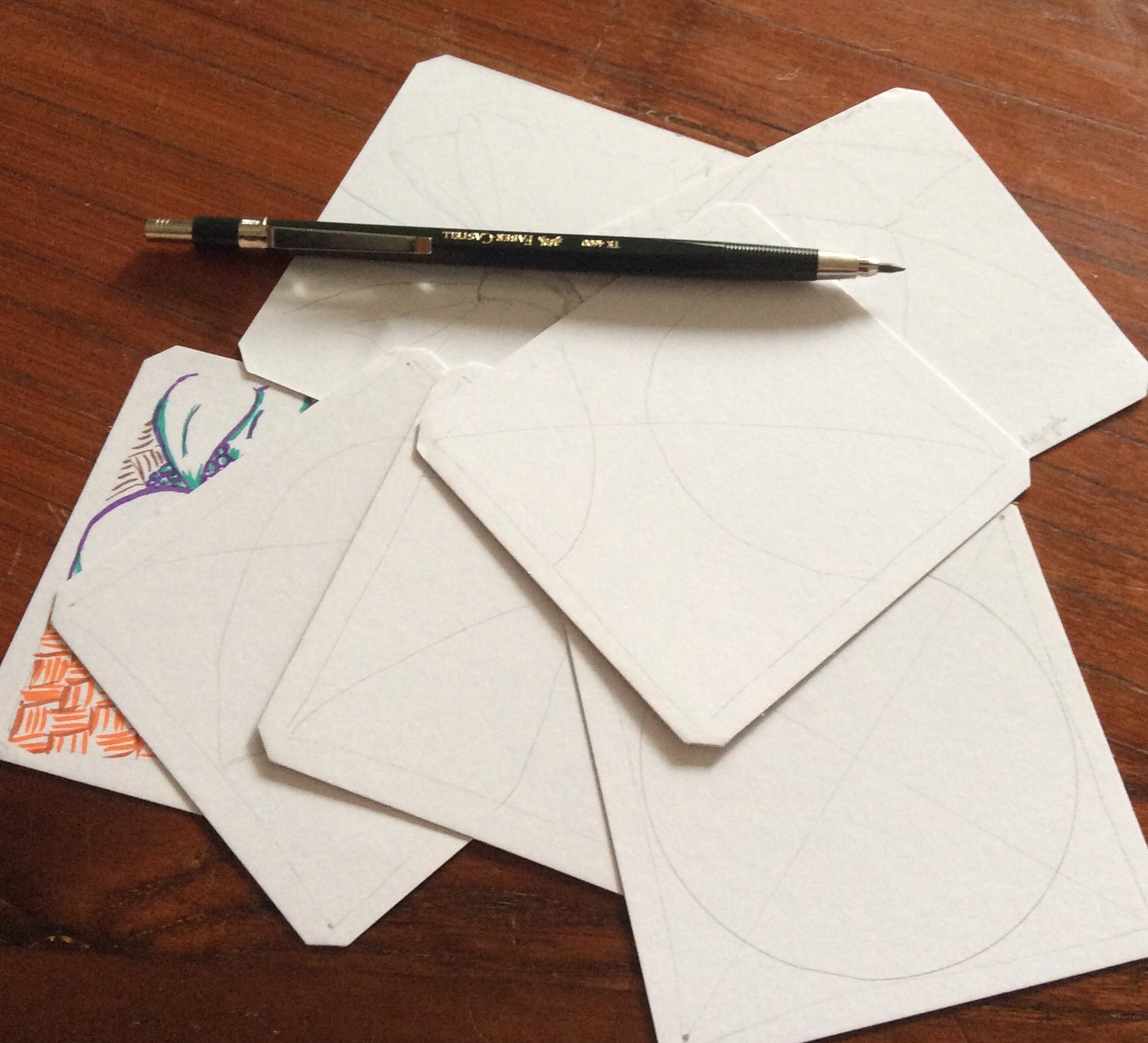
While I am “in the mood,” I thought I would pre-string a few Zentangle tiles. And maybe finally try out those brush pens I ordered. Break some rules for days when I can’t come up with anything to get me started. 

That brush pen set I ordered weeks ago was a disappointment, color wise. I was hoping for a full spectrum of primary and secondary colors. In a way, that’s what I got. But I really wanted a brighter yellow instead of the ochre that was in the package. So I set the pens aside for a while, figuring I would probably end up giving them away. But today, as I was pre-stringing some tiles, I realized that, because I won’t use  he brush pens for any other purpose, maybe it’s a good day to break them out and gain a feel for what such pens can do. One thing I decided to try is tangling with brush pens instead of with a micron pen. I won’t show you what the finished product in that pile of tiles looked like, because the combination of colors yielded truly garish results. However, it was fun experimenting, and I got a feel for what I can do with colors that I actually like. 

We all have days without adequate inspiration–or when our inspirations lead to less than satisfactory pieces, whether artistic in terms of the visual arts, or artistic in our writing. For me, today was a day when I could think of nothing to either draw or write. For hours, I stared at my art materials. Did I want to tangle? Did I want to draw or paint? Nothing called to me.

Turning to writing, I sat with my iPad on my lap in front of a blank post page. No title, no ideas. Just plain nothing. So I turned to my Kindle app and started reading. If I can’t write, reading is always a good substitute for feeling like I am accomplishing something. I had picked out a book that I hadn’t read in years. And while re-reading it, I started to feel like I wanted to experiment with drawing something. Picking up a stack of Zentangle tiles I had set aside weeks ago, I suddenly got the idea to draw some strings. After a few of those, my eyes fell on the brush pens, and decided to see what I could do with them as the only tools for a tile. As soon as I picked up the first pen, I remembered that I hadn’t worked with them since they arrived. Turning to some scrap tiles–ones that I had started in the traditional pencil and micron pen, but left unfinished and unfinishable. On the clean sides, I started to experiment with the pens. Net result: a horrible tangle. I suppose I could have just chalked up the experience to another bad art day. Instead, I chose to see the positive side of what I accomplished: I got a decent feel for working with those pens, even if I hated both the colors and the tangle itself. 

That inspired me to write this particular post. Basically, I was fooling around today because nothing “serious” was coming to me. For the past few days, I hadn’t posted anything because I had nothing to write about. But the fooling around gave me both practice with tools I hadn’t explored and an idea for something to share. 

Fooling around is never a waste of time if something is happening–an idea for a drawing, learning about an art tool, writing nonsense words and sentences, etc. I could have looked at the drawing experiment as a failure. Instead, I chose to view it as a learning opportunity. I learned how to control the brush pen to produce various effects for lines and curves, and for using it to fill in areas. I learned how thin or thick a line I could draw, how to use pressure on the tip in a manner a bit different from a watercolor or oil painting brush. These pens work like neither brush nor marker nor pen. Rather, they work as a combination of the three. Just like any other tool, they require practice and some patience to figure out what technique to use to get a desired effect. I spent maybe an hour playing with them, and I will need several more hours before I feel like I have mastered their use. But that’s all part of the learning process. 

Writing is the same way. Whether I write in response to a prompt or I try something new–like the poetry class I took earlier–each new technique takes time and practice to eventually get it right. There were a few things in the Intro to Poetry class that I chose to skip for now, but I learned something about them. Just because I couldn’t master a form or technique in the time allotted, doesn’t mean I will never master it. Yeah, OK. I will never be a poet, but I took the course to help with writing, not to be the next Elizabeth Bronte. I will keep trying the things I learned and the things I skipped until I feel more confident with the results. The class provided me with a structured learning opportunity, one which provided me with ideas that I can research more fully to feel more comfortable in further exploration.

Months ago, I mentioned that I thought there was a relationship between writing and drawing or painting. I began to explore Zentangling to help with the drawing. There is still much to learn about tangling, but I have a better idea about where to find ideas and inspiration, as well as new patterns. Taking the Intro to Poetry class gave me the same for writing. 

Bottom line: Fooling around is a fun way to learn. 

From now on, I will take more time to play. Maybe it will help my creativity…

##

Posted in Writing process | Tagged , , , , , | 6 Comments

Guest Writer Spot – With A Difference

Click on the links in this re-blogged post for lists of some invaluable resources for and articles about writing, including prompts, uncluttered word processing tools, ideas, and lots more. Thank you, esthernewtonblog for information from your guest writer!

Esther Chilton's avatarEsther Chilton

This week’s Guest Writer Spot brings you something a little different. As many of you know, I like to support other writers and writing institutions in any way I can. Over recent times, I’ve got to know Sarah Del Rosario who is involved with the Australian College of Journalism and Open Colleges, Australia

Sarah has let me know that they have some exciting new writing resources and articles for writers. Please take the time to have a look. There’s lots of useful information, from finding the right app to teach you creative writing, to considering the ‘psychological geography’ of a sentence, to  being aware of your own communicative assumptions, to trying different genres.

***

If you’d like to see your work in my Guest Writer Spot, please contact me here or by e-mail: esthernewton@virginmedia.com. I accept stories, poems, articles – in fact, anything and everything. All you have…

View original post 22 more words

Posted in Writing process | Leave a comment

Seriously

The 10-day class called Introduction to Poetry is finally over. Until I take another class, I can catch my breath. For me, although the course was fun, it was extremely time-consuming. Perhaps because of that, I realize now that I had stopped taking it seriously and just started slapping together assignments–although the flippant approach was equally time-consuming. That just added to the frustration of trying to write in an art form that is very difficult for me. Clearly, not everyone is a poet.

As I approached the second half of the course, I began to think about two things: my own sense of frustration, and frustrations that must be affecting students in k-12 classrooms. First, let me address this course. Then I will say a few words on general public education in the US. 

Two things kept me going through the ten days. The first is that it was only ten days–long enough to feel worthwhile, but short enough to persevere through the difficulty of the art form. In all, my purpose for taking the course was met–to learn more about poetry to help my overall writing–to a degree. That it became so time-consuming was a major distraction and contributed to my frustration. Even before taking the course, I knew how difficult it would be for me. Having elected to take the course anyway, I plowed through the lessons, becoming more and more distracted as the requirements and suggestions seemed to overcome my meager abilities. Part of my problem was that I didn’t feel that I had enough time to master any of the material well enough before being sent a new form and a prompt around which I could not wrap my mind. 

That got me thinking about learning in general and in k-12 classroom instruction. When I was teaching, I had the luxury of designing each student’s curriculum around his or her skills and talents. I taught special education and had relatively small classes compared to regular education. At the time I was teaching, class sizes of thirty or more students were close to the average, despite the research that indicated such large groups were not conducive to healthy learning environments. Anyway, my classes of learning disabled and emotionally challenged students generally fell around 15 students–about twice the recommended class size for special needs children at the time. It was a lot of work to tailor individualized curricula for so many students while making sure each had individualized attention and learning support. The students were worth the effort, despite the huge differences in ability and achievement levels represented in the classroom. 

Today’s educational systems no longer allow for this type of student support, and we continue to lose students in increasing numbers before we can graduate them. Growing dropout rates contributes not to a stronger and unified nation, but to one that is more fractured and weaker. 

It would be wonderful if I came up with a solution to the growing concerns circling public education. Alas, I have none. The issues are too diverse, localized, and factionalized. Perhaps that is why originally, education was left in the hands of the states. When education was all but nationalized under No Child Left Behind, it destroyed any state’s ability to do what was best for their own populations of students. And yet, state educational systems are much more in touch with the needs of their own populations than is the federal government. 

When I take a course through Bloggers U, I have some control, especially since everything is individual study now. I can address each assignment the day it arrives in my mailbox, or I can progress at my own speed by holding on to the emails until I am ready to respond to the next lesson. I can even do the assignments out of sequence, if I want. The point is, I may not have control over the materials, I have a lot of leeway within assignments and I have the freedom to do the assignments at my own pace. That is not an option in public education any more, even if the entity being addressed is a representative one–a given state’s department of education. It is as though we, as a nation, no longer take education seriously. 

##

Posted in Writing process | Tagged , , | 10 Comments

Introduction to Poetry: Day 10

Day 10 Prompt: the Future

Suggested form: Sonnet

To a poet, the writing of a sonnet undoubtedly comes more easily than it can for me. 

It has been fifty years since last I tried my hand at writing a sonnet. It was a torturous process then, and clearly has become no easier in the intervening decades–not that I have tried it since it was assigned as homework in English class. Back then, there seemed to be much time to come up with a classic Shakesperean sonnet. Today, time is short and more pressing–so little future lies before me. 

So, in my need to bring closure to this class, I wrote what can be termed a sonnet in iambic pentameter, but without the traditional rhyme scheme. Mine is just a joke of aabbcc etc. There was no way to get either serious or humorous about this form, at least not today. It rhymes–that’s all I can honestly say about it. Does it make sense? I really wish I could say “maybe,” but I’m not sure. 

I will say that I enjoyed the challenges set for each session, even if I didn’t try all of the forms or devices yet. In time, I’m sure I will–just not today. Maybe next time I take this course. 

The course itself provided me with what I wanted–a chance to learn something about poetry to season my writing. So I am satisfied.

#

The Future of My (eh-hem) Poetry

I have no wish to e’re become a bard,

For poetry to me is very hard.

The sonnet is a form I cannot learn.

Time left is short and pressing in its turn.

*

The lim’rick is a form that often jokes.

Haiku is short but “long enough” to folks.

Poetic’ly impaired as I am here,

It seems no poetry sings in my ear.

*

And yet I strive to write these lines of verse

As though the future holds to me a purse

Of golden dreams to write across a page–

As though of greatest import, at my age.

Yet as tomorrow rests upon a sigh,

The verse I write today will fall or fly.

#

Seriously, it has been fun taking this class. 

##

Posted in Writing process | Tagged | 6 Comments

Markets For Writers

Competition notice from esthernewtonblog.wordpress.con

Esther Chilton's avatarEsther Chilton

Here’s a short story competition for all those of you who are off on holiday, working on longer works, haven’t the time to compose a lengthy short story or who just simply enjoy the shorter story. The 2016 Exeter Flash Competition is inviting entries into its 250 word story competition. Here are some details for you:

1st prize: £100

2nd prize: £50

Entry fee: £4

Closing date: 31st August 2016

There are very specific rules to follow, so do take a look at the competition page.

***

118fef0ea22d12fe20155b1a71dfca82

View original post

Posted in Writing process | Leave a comment

My Top Twenty Websites for Writers

Sites for Writers.
Another “thank you” to Don Massenzio at donmassenzio.wordpress.com

Sheila McIntrye Good, Author's avatarCOW PASTURE CHRONICLES

images Photo: courtesy of wikipedia.org

I don’t know about you, but I rely on the expertise of other writers and bloggers. I have collected an array of blogs that are my go-to resources for writing advice, critiques, editing, grammar, writing prompts, research, publishing, and blogging.

I’m sure you have your favored sites, but I thought I would share with you my top 20 websites for writers. Enjoy and if you have one, you think my readers, or I would like them, please pass the link on in the comment section below.

  1. Fiction University with Janice Hardy – one of all time favorite resources on writing.
  2. WOW- Women on Writing – designed to support women writers through all stages of writing.
  3. Live Write Thrive with CS Lakin – copywriter, editor, and writing coach.
  4. Writer Unboxed – all about the writing of fiction.
  5. The Review Review – a source for all writers interested in…

View original post 260 more words

Posted in Writing process | Leave a comment

Getting more Readers to read your Posts (2 min read)

Thanks to Don Massenzio’s blog, I saw this post and thought I, too, would share it.
Happy reading!
##

Posted in Writing process | 1 Comment