Blogging Fundamentals: Day 2

This post is part of the blogging fundamentals tutorial offered by WordPress. If you are a regular follower of my blog, you are probably not interested in this path. I will try to remember to title all related posts with Blogging Fundamentals so you can recognize and skip them.

For Day 2 of the Blogging Fundamentals tutorial, I am instructed to check out and change my blog title and byline. I worked really hard on that a while back ago, and think I will stick with things the way they are. As soon as Microsoft has stopped downloading all my updates and blocking my internet links between Outlook and browsers, I’ll click on the link just to review any changes that have been made to the WordPress system. I know there have been quite a few that simplify blogging; I just haven’t checked out what has changed.

Did I tell you that I was without adequate internet service for over two months? No, it had nothing to do with bill payment. We moved, and it takes up to three months (I think more like four or five, in reality) to get “new” service started again. That’s one of the many joys of living on a small Caribbean island. They get to you when they get to you and no sooner.

Cheers!

And Happy Blogging!

##

#educ_dr

Posted in Blogging Fundamentals, Writing process | Tagged , , | 9 Comments

Blogging Fundamentals: Day 1

This post is part of the blogging fundamentals tutorial offered by WordPress. If you are a regular follower of my blog, you are probably not interested in this path. I will try to remember to title all related posts with Blogging Fundaments so you can recognize and skip them.

A few days ago, I wrote a great introduction of myself and why I am taking the introductory course again. But I live on an island in the Caribbean, and we have power issues that do crazy things to computers and other electronics. We’ve been having daily power failures for a month now, with no sign of relief. Since the major–make that only–industry here is tourism, and we are in the middle of “low season,” the hotels are having fits because they need to constantly use their backup generators. The generators run on gas. If Californians think their gas prices are high, they should move here and fill up their tanks a couple of times. There’s nothing like paying $90 for an average tank of gas to make $5 or $6 a gallon seem reasonable. The hotels might get a break, but it’s expensive to run those generators, especially when the establishment is running well short of full capacity.  To make a long story short, the power went out, internet service (generally iffy at best) went down, and I lost my post. I’m not sure why it didn’t get saved in my WordPress draft folder, but I have learned that many things done on an Apple product don’t function as expected by Windows users.

Enough with excuses. I’m here because I need to refresh my blogging skills. It has been well over a year since I took this course the last time. At that point, it was more like a traditional online class setup, with a hundred people starting on the same day and apologizing for being behind before the third day assignments come out. Working independently gives me no one to need to apologize to except myself. And I don’t accept my apologies.

The reason that I’m starting with the fundamentals class is because I am not sure I  have mastered them. Best to review old material and find something new than to move too far ahead under the assumption I already know this stuff. Maybe, maybe not. So here I am.

Anything you want to know about me can be found in my About page–probably. I am a former teacher and university educator; I worked in computers back when mainframes were the standard; I retired a few months ago; and I am taking art lessons in my spare time even though I have no talent. Perhaps the only thing I haven’t added recently is that I have taken up Zentangle art. Originally, I started  because it was supposed to be relaxing and tension-relieving. There’s a meditation aspect to the Zentangle philosophy, but I learned quickly that I should stick to the art form of it, as I lack the patience and discipline to meditate. I’ve been blogging about the new patterns I am learning using the book called One Zentangle a Day. I have actually picked up several new followers with the Zentangle posts. Many are professional artists, photographers, writers, poets, or just plain doodlers like me. Other readers have been following me for as long as I have been following them–also a mix of professional and amateur writers and photographers whom I “met” during blogging, writing, and photography classes here at Bloggers U.  Reading their posts helps me pick up a lot of ideas for my amateur work, and I am very grateful for their patience with a little old lady whose hand tremors show up vividly in her artistic endeavors.

Happy blogging!


Posted in Blogging Fundamentals | Tagged , , , | 4 Comments

Dilemma Dilemma

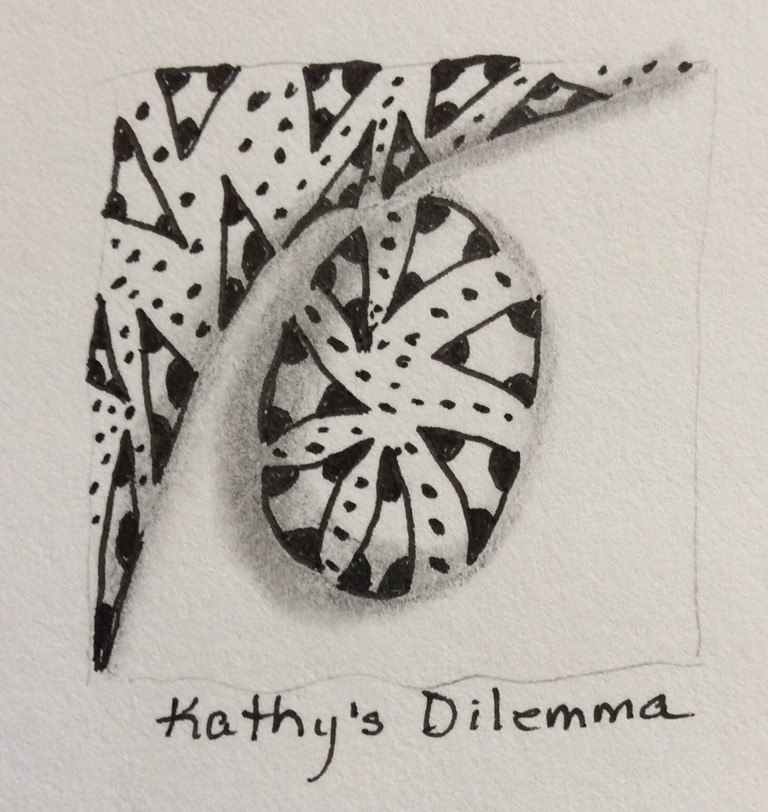
Moving right along in One Zentangle a Day,  I am at Day 23. Today’s new Zentangle pattern is Kathy’s Dilemma. Instead of a second official or unofficial motif, a vine tangleation of Flux is introduced–except that I have been using this modification for some time. 

Kathy’s Dilemma


Rather than create a new tile today, I want to pose a question: What is the dilemma in this pattern? In Rick’s Dilema, there is a paradox; the mind perceives a curve where there are nothing but straight lines coming together. Is the dilemma that the triangles with filled in curves at the corners give the illusion that the white space is the shape? That is, that the triangles “disappear” into the background of the dotted foreground, leaving the eye to see only the white shape within the triangles? 

Oh. OK. I guess I get it now. I didn’t see the “negative effect” before. 

Kathy’s Dilemma makes me wonder how often I see either the foreground or the background–but not both at once–in any given situation? When an image is in front of me, I can generally make sense of any “dilemma” produced by or within it. Often it’s just another optical illusion. But when I think about social or behavioral activities or events, I wonder what I actually perceive. All my life I have tried to see all sides of a situation, with overall more success than failure. My responses are not always in line with others’ perceptions, but that’s probably because I am so busy focusing on one object or event that I forget that those around me may be perceiving something different altogether. When I was younger, I was more able to suppress my reactions. Now, as I approach the natural end of my life, I seem to have lost the ability to self regulate. Oh, not in everything or anywhere; just in relatively familiar circumstances–those where I feel relaxed, or safe. The dilemma here is that it is not always safe–not from judgment by those who do not know me intimately. At least those who know me well feel free enough to ask what I am talking about. Not everyone feels this is socially appropriate. My dilemma is that I don’t always know that there is a dilemma or negative space (as in the negative image of a photograph, not the unfavorable connotation type of negative). 

The remarks I make or questions I pose may seem like babble, but they are not. How well do we assess our surroundings? How accurately do we perceive the world around us? How good are we at figuring out if we are “safe” with the people around us, that we can say almost anything without being unduly or harshly judged? There are many people who can instantly assess their environment accurately and respond accordingly, always correctly. I am not one of them. It doesn’t take too long for me to “get it;” just long enough that by the time I assess, it is often too late. Unintended damage has been done, and there is no way to undo it. 

This dilemma causes another dilemma: Do I never make a comment or ask a question? or do I do what has become natural? Do I continue to try to decide if I can safely respond and let the moment pass? I don’t know. Maybe I will never know. Just like Kathy’s Dilemma can change one’s perception of a drawing, so maybe my remarks can change someone else’s perception of a situation. Is a comment worth the risk? Maybe I am just too old for this…

Happy tangling!

##

#educ_dr

Posted in Art, Zentangle | Tagged , , , , | 2 Comments

A Bit of Planning…

Day 22 of One Zentangle a Day, and it only took me three months to get this far! That’s why I write about the book days rather than calendar days. The book week’s chapter deals with color and talks about using the color wheel. That’s actually separate from the day’s tangle assignment. Call it a bonus, or extra credit.

Today’s Tangle

The Zentangle pattern for today is Tagh, which looks like feathers or scales to me. In addition to Tagh, the author presents an unofficial tangle called Tat. Both will be used in this day’s tangle, along with one or more previously learned motifs. Naturally, I decided to do ZIA (Zentangle Inspired Art) instead of a regular Zentangle  tile. 


Tagh is used for the bird’s wing and around its eye. Tat is the plant life in the foreground around the bird. The foliage is Samson, the spider is Squid, and the web is a tangleation of Dyon. Fescue acts as a filler for too much white space. (Hmm. Should have planned that out better.) Other patterns used for the bird include Flukes (breast), Static (lower body day), and tangleations (modifications to basic tangle patterns) of Poke Root (above the neck),  Nekton (tail), and Yincut (beak). The top of the head is Amaze and Chainging circles the beak. OK. I think I covered the patterns used. 

Tomorrow I will try to play with water color–probably as a wash over a completed tile. I was thinking of putting a wash over today’s tile, but I like it too much to inadvertently mess it up. 

On Planning

While working this tile, I can’t say that I was thinking much of anything except the piece itself. I tried to figure out which patterns to use for different parts of the bird and for the foliage in the background. Maybe if I had stopped to plan the tile better, there would be less white space across the center. All I focused on at first was the bird, the greenery it sits on, and the best use for Tagh and Tat in this lesson. Once the bird and grass were in, I realized There was far too much white space. Time to add some foliage overhead. After I drew in Samson for the foliage and added the spider and web, I sat staring at the blank area, with little coming to mind to help me. So I turned to my mini tiles (see Monday’s post) and found Fescue from one of the first patterns in the book. It helped, and the tile is much less empty. 

Clearly, planning a Zentangle or ZIA in advance of drawing can be very helpful. I suspect that planning is a no-no in the philosophy, as the whole idea of drawing a string and filling in the sections with official motifs that come to mind is part of the meditative process. Since I gave up on the meditation aspect some time ago, I should know better than to create without an action plan. To be honest, I did plan, but realized too late that filling the background with Flux probably would make the piece look too cluttered or too busy, or (worse) detract from the bird as a focal point. So I sighed, got out my minis, and rediscovered Fescue.  

The rest, as they say, is history. 

Happy tangling!

##

#educ_dr

Posted in Art, Zentangle | Tagged , , , , , | 4 Comments

Illusions

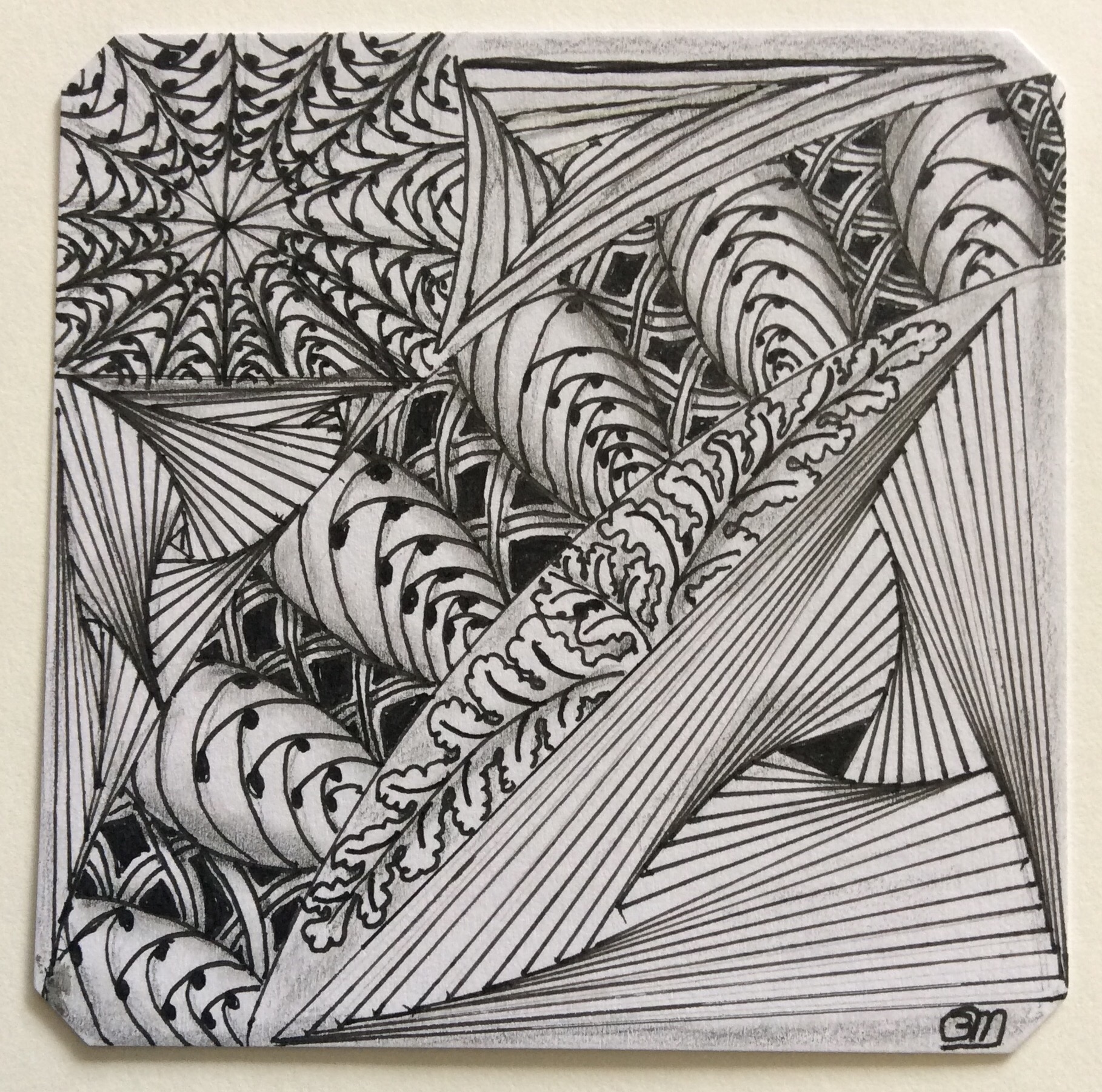
The topic of today’s lesson in One Zentangle a Day was “repetition creating transformation,” which ultimately results in more optical illusion. It’s The book’s Day 21, the last day of Chapter 3: Geometric and Organic Patterns. Today’s patterns are Rick’s Paradox and B’tweed. Although I don’t quite have the hang of B’tweed, I attacked Rick’s Paradox–with a ruler. I love optical illusions, and Rick’s Paradox gives plenty of leeway for creating them. B’tweed also lends itself well to creating illusion, but not as well as Rick’s Paradox. 

Illusions is primarily Rick’s Paradox and B’tweed, with a nod tomSampson and Vega.


The repetitions of Rick’s Paradox in various positions allows for all sorts of illusionary effects, from wave patterns to fans to just plain nested triangles. The freehand “original” pattern is at the top, while the bottom right and center left are multiples of the pattern drawn in different directions. Except for the freehand form, all of the other iterations of the pattern were drawn with a ruler. Why? Because the pattern consists of only straight lines. The curvilinear effect is an optical illusion.

Similar effects occur when B’tweed is drawn much less curvy than I’ve done here. As I said, I don’t quite have a handle on B’tweed yet, but I am working on it. Aside from the need for a more linear effect, I also need to make the “dots” into eclipses so that they more clearly define an intersection with the lines they touch. I didn’t figure that out until I finished working with this pattern in this tile. A novice mistake.

Optical illusions have always fascinated me, and were the subject of a science term paper in the seventh grade. Mirages are just as much optical illusions, but some of those (like the oasis in the dessert) are helped along by environmental variables. The types of optical illusions created here are purely interpretive–our eyes want to add curves where only straight lines exist. Actually, it’s the brain that does that; the eyes merely transport raw data. 

While drawing this tangle, I started thinking about illusions that we perceive in the world around us. Not optical illusions, but social ones. Each of us creates illusions that address who we are and what our role is in society. I wonder how much of what we broadcast to the world is who we actually are, or if we send out illusions of who or what we want to be. Personally, even at age 67, I still don’t know who or what I am. I am not certain I send out the right signals to others. Part of that might be from having been a nerd most of my life. Part may have much to do with the chaos in which I grew up. 

My mother was very into “What will people think/say?” Somewhere along the line, my young mind translated that as, Who I am doesn’t matter anywhere near as much as what people think of me. Being me, I rebelled against this fallicy, and stopped caring so much about what others thought of me as long as I was OK with myself. Then I realized that, for any social entity to work well, it is important to consider others. For quite some time, I spent far too much time making others happy. So next, I swung the other way and managed to alienate people about whom I cared a great deal and really didn’t mean to annoy. The problem is that once you alienate someone, it is very difficult to win them back. When I was studying education, one of the most important concepts was that it takes a great deal more effort to re-teach something that was learned incorrectly than to teach it right the first time. Clearly, in teaching others about me, I had made some serious errors. All I can do now is be patient and try my hardest to let the real me–and my true intentions–show through. Correcting social errors takes much time and patience, neither of which I have in abundance. But I will try.

That’s me. But what about others? I try very hard not to be judgmental, and almost always succeed in this. Experience with individuals over time is what I use to paint a mental portrait of them. Thus, the image is constantly changing. But how do others respond to me and their acquaintances and friends? Do they also take time and refrain from hasty judgments? Some people do, but others seem to make immediate assessments. Does one’s perception of time and its importance cause this? Is it perception of self that matters? Are there combinations of self perception and importance, along with experiences, make us who we are? And how much control do we actually have over the illusions about ourselves that we project? And then there’s the question of how honest our self projections are. So many questions, so many illusions. 

Well, I want to play around with more ways of creating visual illusions using these patterns and a few others that lend themselves to manipulation–like Cubine and Beeline. And some of the weave-like patterns…

Tangle on!

##

#educ_dr

Posted in Art, Zentangle | Tagged , , , , , , , , , , , | Leave a comment

Mini Tiles and Their Uses

Such a prosaic title!

It’s Day 20 in One Zentangle a Day, and I can’t think of a way to get one of the new patterns to work into a tile. 

Ever since the preface to Chapter 2 (Day 8), I have been creating mini tiles (1/4 of a full tile) to serve as  a glossary of the pattern names and to give me an idea of each pattern’s tonal value in comparison to other motifs (the latter was the preface activity). The photo shows one of my sketchbook practice pages and the mini tile I created once I thought I was ready to actually use the pattern. 


For today, Day 20, three new patterns were introduced: Jetties, Sampson, and ‘Nzeppel. I like all three patterns, which remind me of Christmas. And maybe the reminder is what has me stumped. I can think of ways to use two together, but once I try to figure out what to do with the third, my mind goes blank. Specifically, it is ‘Nzeppel that gives me trouble. The book’s example tile uses three more organic patterns, and looks great–except that the addition of ‘Nzeppel to that tangle creates a distortion of the flow of the combined other five patterns. 
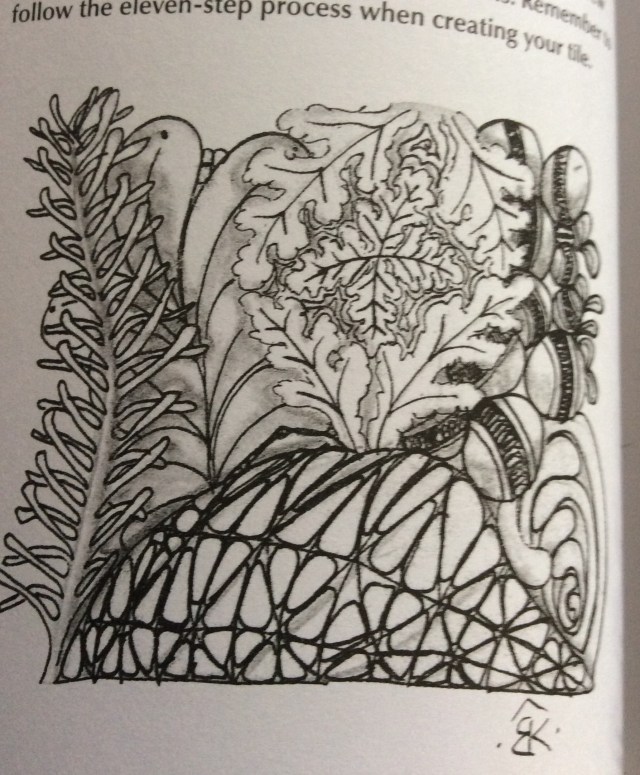
from One Zentangle a Day, page 66


To me, this tangle looks like a rollercoaster cutting through a beautiful, peaceful forest. The author claims that the white space it helps create moves the eye through the tangle. Maybe. It just adds disconcerting imagery to my eye, no matter how I view it. I would love this tangle if it eliminated ‘Nzeppel, or substituted something less jarring in its place. To me, it looks like the author had as many problems trying to tie in ‘Nzeppel as I am having. It should work, right? It’s a pattern that’s both organic and geometrically pleasing on its own. But it doesn’t.

The mini tiles I have created help me test how well patterns go together before I put them on a tile. When I put these three tiles together, I feel dissonance for some reason. Yet when I try ‘Nzeppel with other more geometric patterns, there is a flow. Here are some patterns that I think would work well with ‘Nzeppel. 


Using any of these patterns with ‘Nzeppel should work fine. The pattern just doesn’t work that well in combination with Jetties and Sampson, even though it might work OK with either. 

Yeah, I know. Here I am new to the art form and already I am a critic. Well, I can appreciate dissonance in a lot of art works; just not in one that’s Zen based and is intended to be a main focus in the meditative process. And this is the second time in three book days where the assigned use of patterns leaves me clueless. At least I got a fish out of Day 18.

That the use of the mini tiles can help me decide which Zentangle motifs will work together harmoniously is important to me. As I have mentioned in previous posts, I am no spring chicken. Time is important to me, and I don’t enjoy having to put patterns together that strike me as too contrasting. Unless there is a particular message a work of art is intended to convey, I prefer relaxing art to flow. So when I am stuck with a string area that I don’t know what to do with, I turn to my mini tiles as sources of inspiration, flow, and tonality, the last of which is the reason the author introduced them in the introductory passages to the Chapter 2, of which Day 8 is the first lesson.

There are a lot of good things about One Zentangle a Day, but there are also sources of  frustration. Some of the frustrations I have encountered so far deal with the dissonance described above, and with “how to” illustrations that provide inadequate information, a topic I have dealt with before, especially in the post about the Locar pattern where I question which of the several versions viewable online is the basic pattern (among other complaints regarding the development of Zentangle–the philosophy as well as art form). 

The good things about the book far outweigh my complaints. These include the effort the author puts in to giving the learner basic art lessons on the color wheel, tone and its uses, transitions, flourishes such as the dew drop (which I haven’t discussed yet), and artistic segues into different media on which to tangle (papers, cloth, mica, canvas, etc.), tangleations; tangling instruments from Micron pen through watercolor, ink, colored pencils, and fabric dyes; even jewelry making and ornament creation. She covers quite a bit in the 42-day course, so that learners primarily interested in one art form over another can get some idea of the versatility of the Zentangle patterns when used for other than meditative purposes. She takes Zentangle from meditative philosophy to artistic tool. 

Personally, I gave up on the idea of Zentangle as a meditation tool long ago. I was becoming too frustrated with some lessons and certain patterns to even consider a meditation session while working. 

Not long ago, I was ready to dump One Zentangle a Day and use a different book, at least temporarily. But I found that the flow of the lessons has been, so far, a relatively smooth experience that is rich in artistic information, making it difficult for me to do more than supplement this book with information and patterns from other books and the Internet. 

The best idea in this book is the mini tiles for use in establishing tonal qualities. That I found another use for them–helping me decide which patterns work well together–is a bonus. I hope you find your own bonus.

Happy tangling!

(And I just thought of how using ‘Nzeppel as a window might work. 😊)

##

#educ_dr

Posted in Art, Zentangle | Tagged , , , , , , | 7 Comments

Clutter

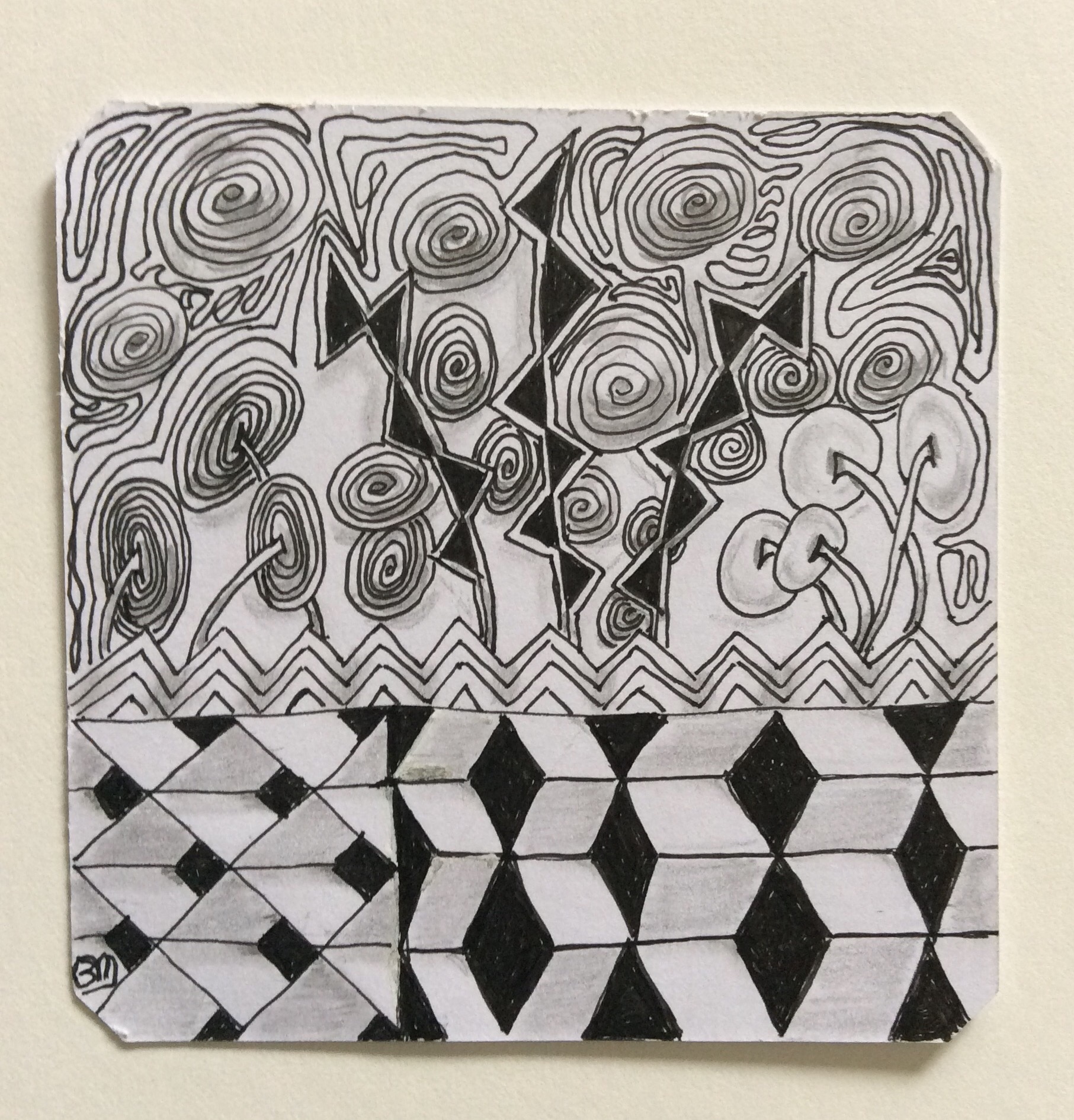
The Day 18 topic in One Zentangle a Day was curvilinear geometric patterns, featuring Gneiss, Cadent, and Huggins as the daily tangles. For Day 19, the topic is geometric rectilinear patterns, and features Rain, Cubine, and Beeline. The latter two are patterns that adorn many of my class notes throughout junior high and high school, as I doodled my way through lectures. My notes always looked cluttered. Today’s tile reminds me of those notes from more than half a century ago.

Geometric rectilinear clutter featuring Rain, Cubine, and Beeline Zentangle patterns


Last night, I sketched a rough draft of this tangle. It seemed to work OK, but looked cluttered and confused, as I had too many curvy patterns drawn. In the final draft, I thought taking out some of the work from the center would free up the tangle and make it a bit neater. Instead, I feel like I have more clutter surrounding a central void. Maybe if I add a watercolor wash… But I have already overworked this piece and don’t want to add even more confusion. 

To most people, rectilinear patterns feel very orderly, as though one is in control. To me, using such patterns give me a feeling of sterility or of an environment that is overly controlled. I wanted the piece to be softened with a few curvilinear patterns, but I think I got carried away. 

Today, I feel as cluttered and confused as this tangle. There is a tension between what I want to do and what I can actually accomplish. That this tension and confusion shows up in the drawing is interesting to me even though the persistence of clutter from yesterday to today is not surprising. I can understand why art therapy had become a big thing among clinical psychologists, especially in institutional settings. It is highly likely that patients’ states of mind are revealed in their artwork, just the way it seems for me. As I study my own tile and find the glaring areas of white, I wonder if there are holes or voids in my life that I have either suppressed or ignored. Might those be adding to my sense of confusion? 

Is my perspective on life so different today than yesterday? In the previous tile, there was also a lot of white space; but it felt natural, like it belonged. Today’s blank areas appear to be chunks out of the whole–like I meant to fill in the area but forgot or obliterated the space. And the shading… Hmm. Should I think about this–overwork it as I have overworked the curved patterns–or should I just move on, aware of unresolved and unknown issues, but setting them aside until they decide to reveal themselves? 

Maybe it is time to meditate on how to proceed. After all, meditation is part of the Zentangle philosophy. Maybe I should let it happen. Maybe meditation will help me make more sense of the clutter in my mind.

Happy tangling!

##

#educ_dr

Posted in Art, Zentangle | Tagged , , , , , , , , | 1 Comment

Turn 45 Degrees…

After botching up several attempts at Day 18 in One Zentangle a Day, I decided to change my perspective. So, I started by turning my tile 45 degrees. Instantly, I got an idea to do something a little different with Day 18’s tangle. Instead of a random string, I decided to start with a fish. Why a fish? Probably because I can’t draw frogs. 


The day’s patterns focused on Gneiss (the eye), Cadent (the upper body), and Huggins (the lower body). Just turning the tile gave me a new perspective on drawing and a way to put those three patterns together in a way that didn’t feel as contrived as my previous attempts, the best one of which is below. 


In the lower photo, I messed up my intended perspective when I drew Finery (upper portion of tile) without receding the right side in the distance. Maybe it’s because I used too many patterns. Or maybe I lost perspective. Everything else came out as planned–sort of. 

That I call a random string tile more contrived than a deliberately shaped string gives you an idea of just how much my perspective changed. For whatever reason, the fish feels more “natural” than the other tile. It’s that feeling of “naturalness” that I associated with contrivance, even though it is pretty clear that a random pattern is generally more natural, in that Nature seems free-flowing and without conscious reference to shape. But there it is: I turn the tile and my feelings about perspective change as well. 

The idea for the fish came from a book I am reading, Charles Stross’ latest Laundry novel titled The Nightmare Stacks. At least, I think that’s where the idea came from. You see, in the book there’s this passage that deals with water-dwelling piranha-like alternate world creatures… Well, never mind; my fish hardly looks dangerous. Except for the eye, maybe…

Earlier in Stross’ book, there is a passage about how the way one perceives the world changes with the time of day–such as when you generally see a particular place only during the day, and suddenly you see it in the dark. It turned out that is not what was occurring in the book, but it made me stop to think about all the places that were familiar to me at one time of day but that seemed totally new when seen at another. For example, when we lived in Palo Alto, California, the noon time starkness of buildings I passed each day was such a contrast to the genial morning newness or the mellow evening patterns of shadows cast by the local businesses and homes. Or that first day in autumn in New Jersey after the trees turned to their brilliant yellows, golds, oranges and reds, virtually overnight. Or re-reading a book in my senior years that I last read forty years earlier… Time and perspective seem to change together. Maybe part of that is because we gain experience or fail to see the newness of a scene when we first come across it in a new light… 

The same with writing and art. Our perspectives, our passions, our language–all change with time and experience, yet all are fresh in their own way. 

Sometimes, all it takes to change the way one thinks or attack a problem is to step back, or perhaps to view the target from a different angle. Turning the Zentangle tile forty-five degrees gave my mind a new perspective on how to combine three patterns–only two of which seem to actually complement each other–in a way that I could find pleasing. Plus, the turn gave me a way to insert what I have been reading into the work, too. Unintentionally, of course. 

Makes me wonder how many other things I can turn just 45 degrees…

Happy Tangling!

##

#educ_dr

Posted in Art, writing | Tagged , , , , , , , , | 2 Comments

A Little Novice Discovery

Once again, our power went out and I have all doors open to allow for a cross breeze. I guess we’re lucky to be on an island that is not currently undergoing a–well, whatever you call a total absence of air movement out at sea. (Had that word just a moment ago, but it flew off just as I got to where I wanted to use it. Oh, well.) Unfortunately, our “villa” community doesn’t have a backup generator, so the A/C (or airco, as it is locally called) is off. Hence the gratitude for the cross breezes. But it’s still hot.

Which turned out to have a revelation. 

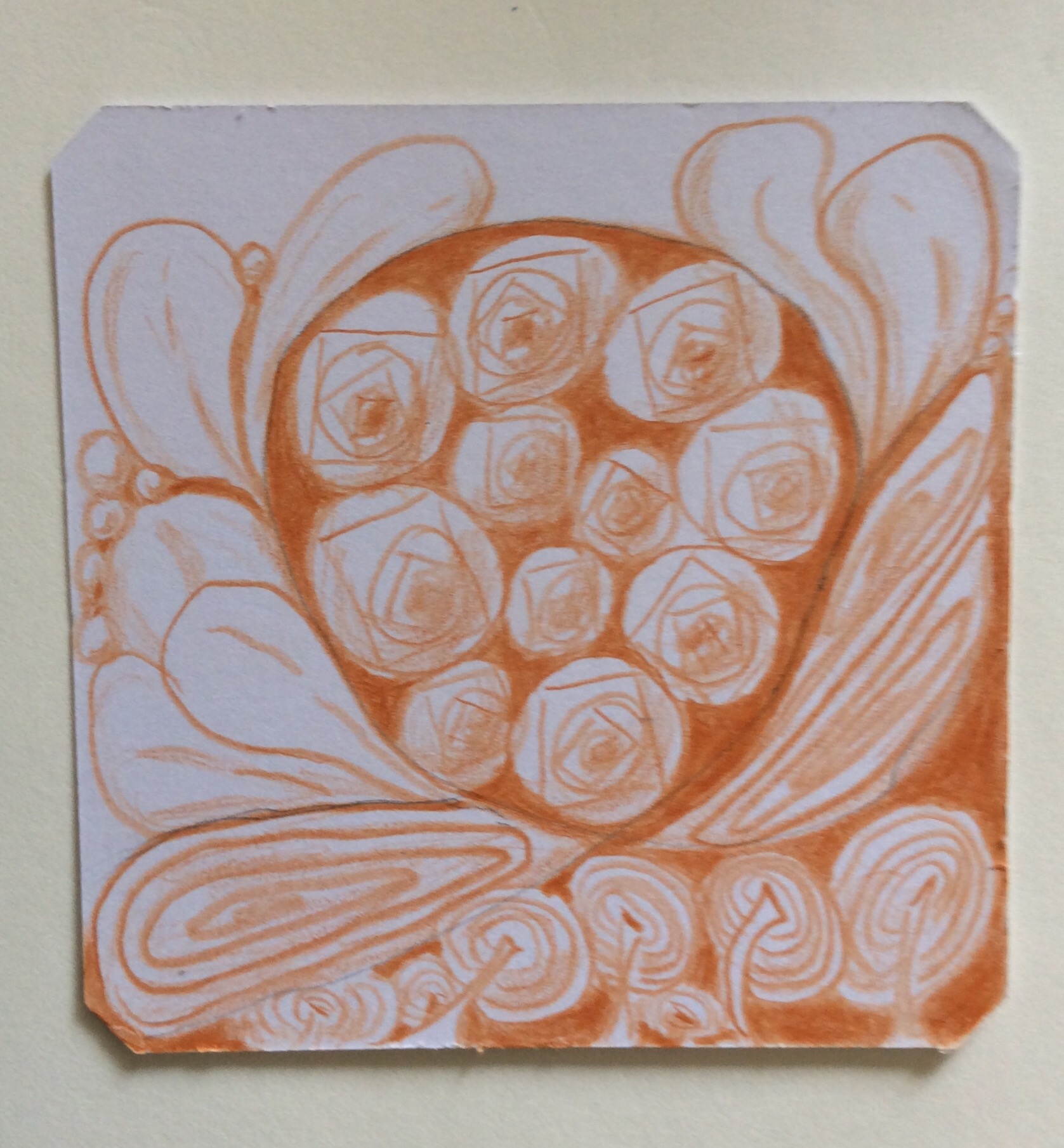
Last night, I was working on a Zentangle tile, but decided to use colored pencil instead of the Micron pen. I already knew erasure wouldn’t work well on the tile surface, but that was OK. Instead of using my Prismacolor Premier pencils, I grabbed the less expensive Prismacolor Scholar pack and set to work. I made two novice blunders right off: I drew my string (boundaries) using graphite pencil instead of the color pencil; and I didn’t sharpen the pencil soon enough. The graphite pencil lines seem to have been enhanced by the color pencil (terra cotta, if you’re interested). The pencil lines actually darkened considerably as I worked over them. Or maybe the terra cotta was darkened by the graphite, which is more likely. Either way, by the time I noticed what was going on, it was too late for erasure without destroying what I had already done. So, lesson learned #1: when using colored pencil, draw the strings lightly in the colors that will be used.


As I drew, I began to realize that, unlike when using pen, a pencil needs to be sharpened often. That’s a lesson I am not good with even when I sketch in graphite, but it seems more important to pay attention to the keenness of the point when working in colored pencil. I knew that the Scholar line very, very quickly loses sharpness of point, but didn’t want to stop in the middle of a pattern just to hone a pencil. Result: thick and blurry lines as the pencil point vanished. Lesson learned #2: either use a higher quality pencil that does not dull so quickly, or sharpen after two or three iterations of a pattern; and definitely do not start a new motif without sharpening. Maybe I can use the excuse that I was drawing late at night, with inadequate light and very little patience. However, I knew about sharpening, and I knew the point was dulling. I just didn’t stop. 

Today, when the power went off again (a daily occurrence, although not always at the same time; and yesterday we had two outages–one that started just before midday, and another in the late evening), I thought I should finish up the tile I started last night before succumbing to sleepiness. Why I would want to draw in this heat is beyond me–I should have been outside where cooling breezes blew more strongly than my home’s cross breezes. The tile, however, was more appealing at the moment. What I learned, though, is that the heat helped the wax-based colored pencil flow better, not only as I drew or enhanced, but also as I laid down color. Recently, I had learned of an expensive drawing board that has hot and cold spots in it, with the idea of melting the colored pencil for a smoother and flowing finish. When I saw the price of the Icharus, I decided it wasn’t a tool I am ready to add to my arsenal. But I think I achieved a similar effect because of our weather. In the heat, not only did the color seem to melt off my pencil point (yes, yes–I kept sharpening it; last night’s lesson paid off), but the surrounding color seemed to melt into itself as I worked. 

The tile as pictured may not be quite done. I need to see what happens as I apply more layers of color to the background. The motifs will not be changed, as my tracing abilities are sorely lacking. There is no good way of getting rid of the graphite pencil marks, even though I drew them so lightly–or thought I did. And I don’t want to work the drawing too much, as it will get both too busy and too sloppy. But I do want to see whether I get a big wax bloom from the heated flow of the pencil, and I want to see if the flowing areas of color hold. So much to discover… So neat to be a novice with the desire to see What If…? 

Happy learning!

(And the power has just come back on! Coincidence? I think not.)

##

#educ_dr

Posted in Art, Learning art, Zentangle | Tagged , , , | 5 Comments

Bedraggled

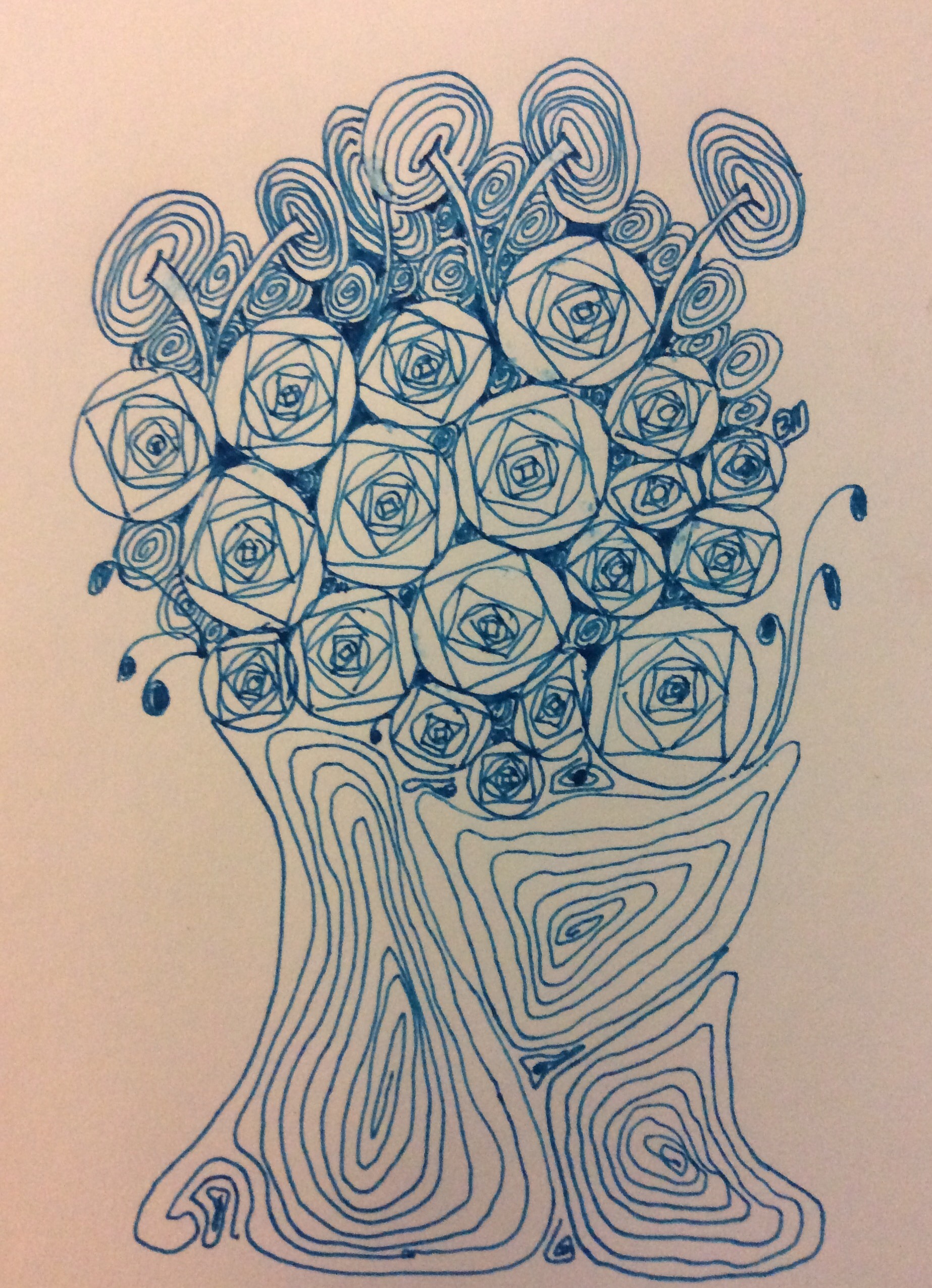
At this moment, I feel totally bedraggled. And I think that came out in my Zentangle Inspired Art, or ZIA. Day 17 of One Zentangle a Day gave me three more patterns yesterday, but it wasn’t until today that I thought of a way to put them together, along with other patterns, into a “whole.” Today’s motifs were Vitruvius (the circle within square within circle “flowers”), Courant (the somewhat wood grained pattern), and Sedgling (the stemmed spiraled flowers). Not only did I not like these patterns, I did them in turquoise (my favorite color) using a very fine ballpoint pen with (I soon discovered) non-permanent ink. The pen point dragged, the ink ran, and my concentration went pfft. 

Bedraggled. ZIA composition using turquoise Pilot V-ball 0.5mm ballpoint pen on Canson 65-lb sketchpad paper


See? Bedraggled. 

The overall idea is fine, but the outcome looks the way I feel–clunky, tired, not quite what I intended. And that pretty much defined today.

If you’ve followed this blog long enough, you know two things about me. First, I live on a small island at the edge of the Caribbean Sea; specifically, I live in Sint Maarten, the Dutch part of the island of St. Martin. (The other side is French.)  The second thing you might know is that I did not want to move here three and a half years ago. I am still on the island, and still trying to adapt to life in a country smaller than all but one small town I have ever lived in. Today was just one example of what I have tried hard to adjust to, without enough success. 

Today was my bank day. Unlike in many parts of the world where you can go into a bank (assuming you don’t just do everything online) and be out in less than ten minutes, here you can plan to picnic while waiting in line. And I had to go to two banks today–one to withdraw money; the other to pay bills like mortgage interest, condo fees, and the power and water bill. Also unlike “back home,” I am still waiting to be approved for online bill payment at both banks. I have already been waiting almost two months, but who’s complaining, right? This is all just part of life here. You get used to it, even as you grumble with the other customers in line about the service–for two hours. At least the wait was under an hour at the first bank. But I forgot about the local bank ban on internet connected devices (even though I can only get as far as Amazon Kindle books on my Paperwhite), and hadn’t brought (or bought) a paperback book or magazine with me. Yep. Almost three hours of waiting in line with nothing to do but get more frustrated. And it was my own forgetfulness that did me in.

Waiting. In the Caribbean. It’s not just waiting for a good internet connection to be installed at home; it’s also learning to wait for almost everything here–the banks, the service, appointments, the power to come back on… Let me tell you, I am grateful that my veterinarian finally went to appointments out of self preservation (and furry patient consideration, I think). 

Clearly, it gets easy to become bedraggled from waiting when you actually live in “Paradise.” 

So when I started this ZIA, I was not doing too well physically or mentally. I wasn’t happy with putting together the three tangles because I am not terribly crazy about any of them to begin with. And the power went out with humid heat simmering outside and eventually inside.  It was a challenge to come up with a way to use these together, especially under the cumulative conditions.  

Too late, I realized that this grouping has potential. The “vase” can easily be morphed into a frog or fish shape; the “flowers” can be placed better with a different “fill” pattern. The main bouquet flowers can be spaced better, a felt-tip marker can be used instead of the V-ball .05 ballpoint pen with clearly non-water resistant ink, etc., etc., etc..

Maybe the waiting gave me insight in hindsight.

But I still feel bedraggled. 

Remember the meditation process as you get ready to Zentangle. Today, I forgot. 

###

#educ_dr 

Posted in Art, meditation, relaxation, Zentangle | Tagged , , | Leave a comment