Another Day to Waste

Today was just another day of plans gone awry because of variables beyond my control.

Or were they? 

Beyond my control, that is. I could have gone to the bank early today, but my husband made an appointment with an Internet provider. But the company representative’s flight from a conference arrived very late last night and he decided to take the day off. OK. I get that.

Last Friday, the community gardener had promised to wash my car–it really needed it. But he got pulled away when the garden guys game to spray the greenery for pests and couldn’t get to it. He stopped by this morning to do the promised service. I was so grateful to get the car washed that I didn’t care that this would cut into the rest of my planned day. 

Living on the island of St. Martin, I have learned a great deal about plans just fizzling into the nether spheres. I have learned, for the most part, to go with the flow of the balmy breezes. Not in all things, but in enough that, back home in the States, would drive me to distraction and great anxiety. Back home, I was deadline and appointment driven. Here, I just accept that the Fates–or God–have chosen a different path for me this day. 

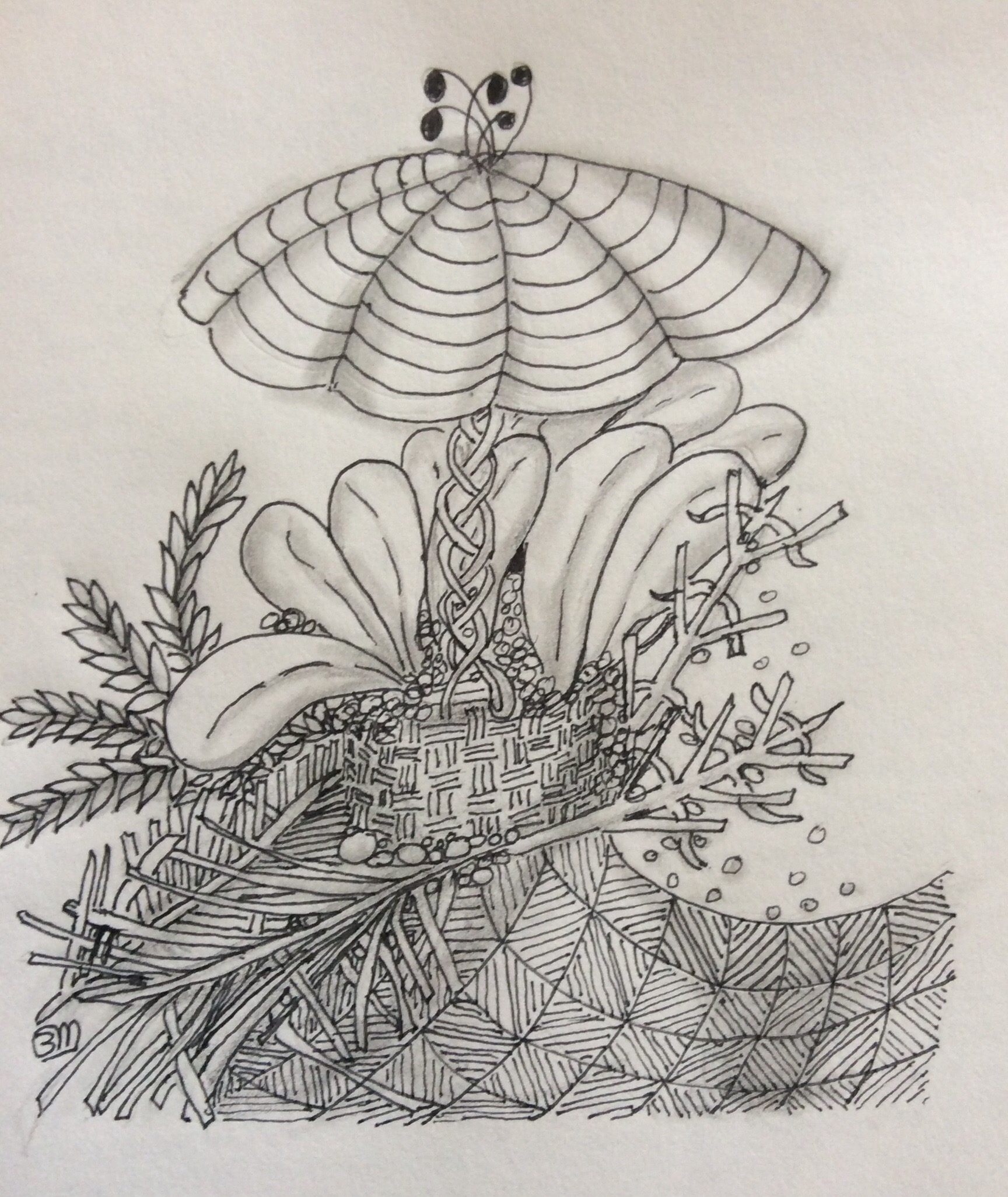
Instead of getting all bent out of shape from my morphed agenda, I decided to finish tracing in ink a ZIA I did in pencil over the weekend. I had lost the light to finish working, and just set it aside. 


Today, it didn’t come out as well as the pencil drawing, but that was so light that even with bright daylight streaming into my living room I still could not trace properly. Worst of all, I lost my focus for shading, and erased several times before finally just letting it be. Not my best work, but infinitely less stressful than if I had produced it in ink from the start. 

But life is like that. We forget how often we need to adjust to feel productive in a day. 

Was I productive today? It depends on how you define productive. Did I accomplish today’s goals? No. Did I accomplish anything at all? Yes. I finished this drawing. I was blessed with a new day; when original plans went awry, I did not panic and become anxious. I went with the flow and found something interesting to do. In this case, I completed something I could not finish two days ago. That is an accomplishment for me in itself. 

Today, I was given another day to waste or to accomplish my original tasks or adjust to fit within today’s confounding interruptions. Did I waste another day? Depends on how you view life. I don’t think I wasted a day, and that counts for a lot. 

Happy tangling!

###

#educ_dr

Posted in Art, meditation, relaxation, Zentangle | 4 Comments

What the…?

It’s so frustrating! 

Those are not the words I typed–or tried to. 

It happens on my laptop, but not nearly as much or as often as on my phone or tablet. I type one word, the program changes it to something that doesn’t even make sense. Is this the spelling checker? Or is it faulty or inadequate grammar check programming? Or is it me?

Lately, I try to be much more careful about not hitting “send” before I read over a message I have keyed in. It has been far too frustrating to hear from a friend that I have insulted her, or to read what I wrote in a response to find what was sent or posted was little more than gobbledygook. Most of the time, I can’t even figure out how the programming came up with what ended up being sent–even the first few letters are different from what I remembered typing. 

As to posting a blog–why doesn’t the spelling/grammar checker show me what it interpreted before I publish? Each post must be checked in the preview pane, since I see only the right words in editing mode before I publish. Why does the program wait until after I preview or post to come up with the scrambled message? So often, I check what I wrote carefully, and so don’t preview before adding categories and tags and hitting the return key. Under the assumption that what I see is what will appear in the published post, I tap on “publish” and go on about my business. If I look at the post later, I see stuff like ghrrunt trug sb nshwr instead of next to the computer. Even the word lengths and character counts are different! So now I try to remember to check. But if it’s the spelling checker, how do non-words get into the post?

There are times I can’t even figure out what I intended. It’s been a lovely day turns into Insa began lively drips. What?? What does that even mean? Where did this wording come from? Why can’t the program leave what I wrote alone? I only asked it to check my spelling, not change my writing!

Worse, a string of words in one paragraph has been randomly copied by the program into the middle of a sentence in a way that makes a whole passage meaningless. It’s been a words in one paragraph has long day, is an example. 

Maybe there’s a strange little imp living inside my phone and her cousin lives next door in my iPad. Maybe they get their kicks from making me crazy. That’s the only explanation I can give for the incomprehensible gobbledygook that gets published or sent. 

The only other explanation is that I really am losing it and substituting strange letter combinations, thinking they are real words. Talk about getting lost in one’s writing…

These changes all occur randomly. Some posts or messages go out perfectly while others–well…

If only I could be sure it’s the imp and not me… 

##

#educ_dr

Posted in Uncategorized | Tagged , , , , | 4 Comments

Moving On

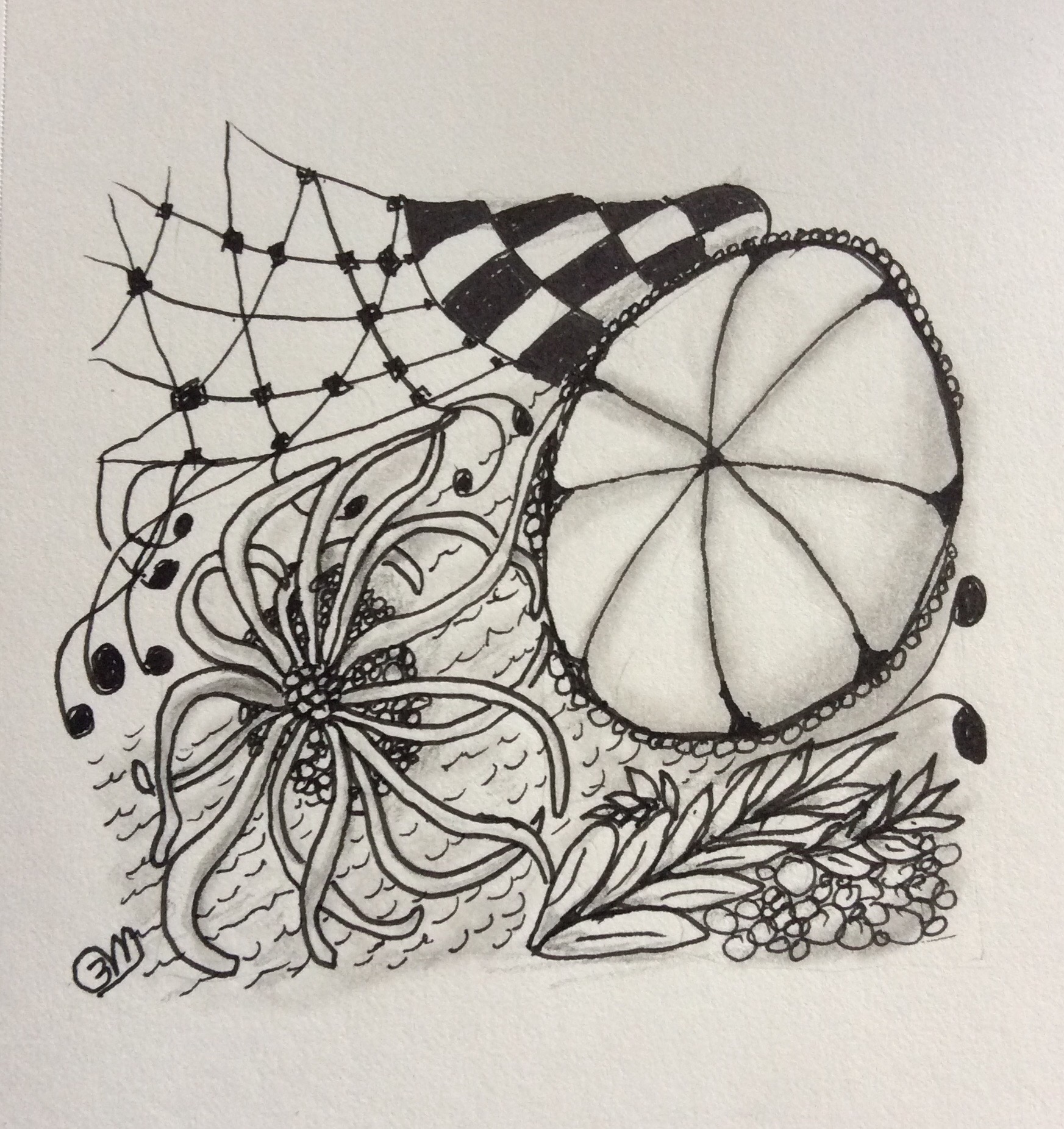
Today, even though my hands were tremulous, I decided to do one last Zentangle or a ZIA. Hopefully, the tremor is temporary and my hands will be steady again in a few days. If not, well… I still have time to practice Zentangle patterns when my body is cooperative. In the meanwhile, I will concentrate on drawing and painting.

This Zentangle was drawn too quickly and imperfectly for me to consider it finished….

For the last 2 months or so, I have been practicing various tangle patterns in my sketchbook and on 3.5″ paper Zentangle tiles. I spent several hours a day trying new combinations of patterns, or trying to master tangles that are particularly difficult for me to draw, whether due to a trembling hand or lack of coordination or inability to get the feel of a pattern. Instead of the meditative benefits of doing Zentangles, I have found myself getting more frustrated, as many of you know. Following the lessons in One Zentangle a Day, it has taken me all this time to get through Day 16. Although I hope to return to this drawing form in the near future, for now I need to set it aside, maybe picking up a new doodle from time to time (there are still several presented in this book and many more in the other books I have). I feel much better when I am drawing what I see or sketching from a photograph or computer monitor. That is more meditative to me than learning Zentangles. 

Basically, as with any new art form, the art of Zentangling takes a great deal more time than I had anticipated. I have followed other One-a-Day drawing books that were more realistic about how long it take to practice a skill. According to the book, I should need no more than about half an hour each day to do a lesson. Although that may be true for many, it has not been true for me. Not only have I often needed hours to feel comfortable with a lesson, there have been many times when I have practiced and drawn for days, trying to get the hang of putting certain patterns together, and reading or viewing other sources about such things as tonal quality and texture, especially as it relates to finished tiles or drawings in my sketch book. I don’t think I am too old for learning new things; I just think that the timeline established in this particular book is not correct for me. But I have learned.

One thing that attempting Zentangle has done for me is make me more aware of natural shading in the absence of a model. It’s not that I haven’t done a decent job of shading my attempts at drawing before; it’s that I really had to think about depth when creating something from my imagination. Should this be more 3-dimensional? Is the shadow deep enough for what I have in mind as background? Is it clear that this tangle is supposed to be the focal point? etc. etc. etc. In my drawing, I simply draw what I perceive so that the shading comes from what I am seeing in front of me. With doodling, I need to think more carefully about where I want my light source. And it is not always the same as I turn the tile to add strokes of ink or shading. 

Another thing that I have been mastering through Zentangle art is patience. Mostly, I have determined that I don’t have any, but that concentrating on drawing has helped me bring some of my impetuousness under control, to some degree. If I think long enough, I can probably come up with a dozen things I have learned so far while practicing tangles, but I am too impatient to think harder right now.

Taking what I have learned so far, and not doing a very good job on the last Zentangle I will share for a while, I am setting my pens aside to think more about other art forms and writing. For one thing, it is time to return to completing a book on changing handedness for writing, the project that originally took me to my drawing teacher. There are other projects which I have put on the back burner, too, such as returning to my lessons now that life is settling down around me again. 

Right now, it is time to pour another cup of tea and figure out where I left off with interrupted projects and which I want to return to first. That’s a form of meditation for me–tea and reading, or tea and reviewing, or tea and…

Happy drawing!

#educ_dr

Posted in meditation, writing, Zentangle | Tagged , , | Leave a comment

Impermanence

While messing around with Day 15’s three tangles–Yincut, Locar, and Verdigogh–I got an idea that would also include the three patterns from Day 14–Dyon, Chainging, and Keeko. It’s not a Zentangle, nor Zentangle Inspired Art (ZIA); but I think I am through with the whole concept of a meditative art. Instead, I am simply going to learn as many patterns as I can and concentrate on putting them together into a doodle art form. 

So, while doodling away with just pencil (nice, impermanent, erasable pencil), I started to think about the whole idea of permanence and impermanence. Working in pencil, and with the idea that I was merely experimenting (that I could change any or all marks before putting ink to drawing), thinking about impermanence came almost naturally. This, of course, made me wonder if I were meditating; which made me question yesterday’s rant about whether or not Zentangle could indeed be meditative–for me, anyway. I decided that, for me, the idea of permanence in learning a new art form should be considered with the word learning in mind. The process of learning should allow experimentation, erasure, and change. In learning, one does not go back to the beginning to learn more; rather, previously learned knowledge and tasks are built upon to learn a new level of knowing or a more complex task. So why beat myself up when I have a good Zentangle idea but need a lot more time to learn or master a new pattern (and practice like crazy with a pattern, once I know what it looks like) to complete it? 


As you can see, there have already been some erasures. The entire piece is done in pencil–deliberately today, not because I forgot to switch to pen. Am I finished with it? No. But once I have the rest of the drawing constructed, then I will attempt to trace over in ink. With my history regarding tracing, some areas of the patterns will morph into something new and permanent, whether intended or not. I don’t like the idea that the erasures will show and that the paper’s texture will be changed where the erasures occurred. But the learning process is where I should allow myself to make mistakes and to analyze and correct those areas in which I lack skill.

The idea that the drawing can be reproduced at some future date, after the patterns have been truly mastered and there is a greater feeling and understanding for the art of tangling as a whole, is itself reassuring. A later work will be permanent. Today’s work can be considered impermanent even after application of the indelible ink that grants it permanence. 

The same goes for writing. What I write in a blog is impermanent, even though it never disappears from cyberspace. A post has a feeling of impermanence, even if it has been edited and “published.” Some writers I follow are writing and posting chapters of a book each day or so. I often wonder if the later book or ebook will be exactly what appeared in the blog, or if the blog is a testing ground with some idea of change involved. When I write or participate in a writing challenge, I never have the idea that what I put out there is anything more than practice–an exercise or experiment in writing that isn’t final and permanent in intent. It’s just fun. I have no more expectation that my writing will make me a writer, any more than I think that posting artistic endeavors makes me an artist. It’s just fun to do and to participate. And I might learn something new, even at my age. 

It’s a learning thing.

Draw on! Write on! Have fun!

#educ_dr

Posted in Art, meditation, writing, Zentangle | Tagged , , , , , , | 2 Comments

Locar: Fact or Fantasy?

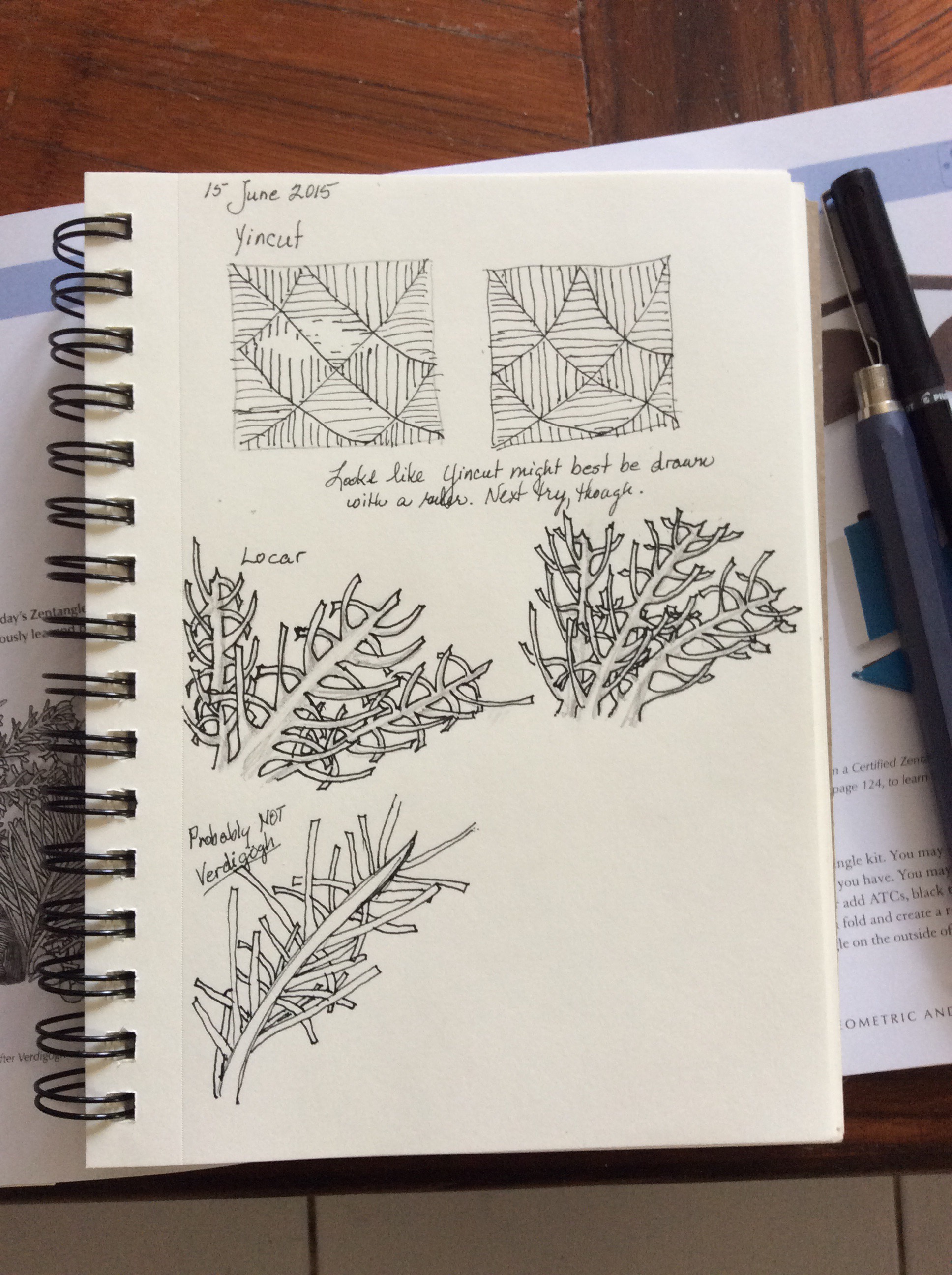
Frustration with the Zentangle pattern Locar took me to the Internet and YouTube again today. Apparently, I am not the only one frustrated with Locar. And since the “official library” on the official Zentangle site no longer maintains its images there, there is no way to determine which of the sites in Google or Pinterest are the basic pattern and which are embellishments. As you know, I have been following One Zentangle a Day. Two of the three patterns introduced today are more difficult than anything I have tried to date. Although there are tons of postings for most tangle patterns, there are too few postings on the pattern Locar to figure out how it should be  drawn “officially.” The simplest form is easy enough to do, especially following what appears to be the only Locar video on YouTube. The rest appear to be tangleations on the simple pattern. One site, labeled “official,” may or may not be the actual pattern. How is one to know? 

Here is what today’s attempts at three patterns looks like:


Granted, I didn’t use the smoother and finer-nibbled Micron pen in my attempt to draw Yincut, Locar, and Verdigogh; but the fact that there was not enough guidance in the book for the latter two–and that no two posted pictures of Locar look the same–makes me wonder about how “official” any Zentangle pattern is. I am feeling like, since the patterns no longer live on the official site, the original developers (proponents?) of the whole meditative idea of Zentangle have tired of it and given up. Has Zentangling morphed and gone off on its own? Even though there were training seminars scheduled for this month??? 

Here is what the only YouTube video of Locar looks like. Below is a photo of what is in my book. In Pinterest, you can see this page more clearly, as the photo is probably the publisher’s image. 
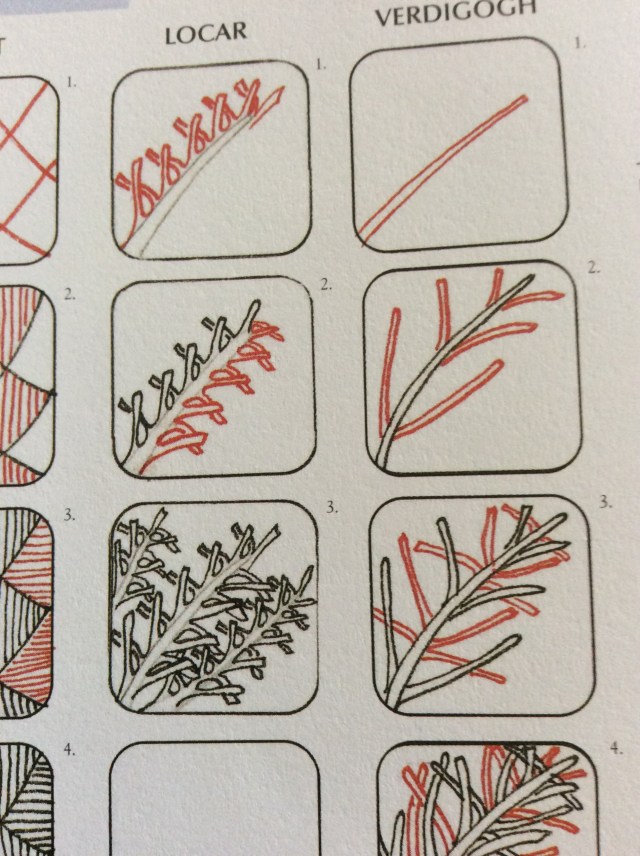

Even the two views could easily be different patterns, they are so different. The Pinterest picture labeled “official” can be found here, and is probably the right one, with a second pattern echoing off to one side. It is, to me, the nicest version–nicer and easier to step up to than the version in the Z a Day book. 

So what is a novice to do? And which version is a novice to believe? For whatever reason the originators decided to take the patterns off their web site, I hope they are happy that there are all us novices out there who are simply throwing up our hands, saying “This is ridiculous!” And either moving to a book that is much easier to deal with, or giving up on the whole idea of tangling all together.

What I am going to do is use a different series. I had downloaded a three-book series by Olivia Summers from Amazon called Zendoodle: The Mastery Series. (I still haven’t figured out how to copy an Amazon link on my iPad; sorry about that.)  This may not be an “official  book,” but it is simple to follow how to draw the patterns, and doesn’t pretend, as I am learning something new and getting frustrated, that I am meditating. Maybe, too, the founders of Zentangle need to stop pushing the “there are no mistakes in Zentangle” line–of course learners will perceive errors and attempt to correct them. I know several true artists, and they all make and try to correct what they perceive as errors (even when I can’t see anything wrong). For many of us, it is part of our nature to self-critique. If we didn’t, we would never grow. Creativity, including creating tangleations on tangle patterns, means we need a ruler against which to measure our base-line and learning efforts. When no “ideal” is available for us to check against, what is the point, and why pursue a philosophy or named art form? 

Sorry. I have been wondering for days whether Zentangle is a real philosophy of meditation or just a marketing gimmick. I definitely think the pattern Locar is a fantasy, since there appear to be no two “exemplars” of the pattern anywhere. And I do not think it is “unartistic” to expect to see what the basic pattern actually looks like; I don’t see how anyone can judge creativity if no two base-line patterns are the same to begin with–are not “factual” as a base-line. 

Locar has become a fantasy to me. I don’t think anyone knows any more what it is supposed to look like. I also think the whole idea of Zentangle as a form of meditation is a fantasy; either that, or it has morphed into a “non-idealistic” state and out of the developers’ control or original ideas. Maybe the originators have split up and are arguing about who owns which portion of the concept. I don’t know. But I will continue to learn from artists their ideas of doodles–yeah, yeah; tangles–so that I can use or embellish the patterns as I choose while creating art that is meaningful to me. 

Later today, I will decide what Locar is to me, and use it as part of a tile. Right now, because its name sounds so Nordic and Viking-like that the simplest form, as shown in the Locar YouTube video (see link above), is the one I will choose. At least I can draw it without getting frustrated and feeling very un-meditative. 

May all your tangling be bright!

P.S. If the links don’t work, blame it on the iPad, which has its limitations in WordPress and many other sites. Or blame it on my inability to learn simple things. Either way, a good search engine will get you to all the links. 😀

#educ_dr

Posted in Art, meditation, Zentangle | Tagged , , , | 2 Comments

Got Nothing…

Three new tangles today; not a hint of inspiration yet…

Clockwise from bottom: Dyon, Chainging, Keeko. Patterns on quarter-tiles (1.75″ X 1.75″).


Maybe tomorrow I will come up with an idea for putting all three together. Maybe tomorrow these tangles will inspire my writing. 

But not today.

Draw on!

#educ_dr

Posted in Art, Zentangle | Tagged , , | Leave a comment

Created Unequal


Instead of moving on to the next “day” in One Zentangle a Day, I decided to try another experiment with transitioning from one pattern to another with similar characteristics. Deciding to do this exercise in my sketchbook instead of on a tile, and forgetting about lightly penciling in a string (drawing area for, or barrier between, patterns), I produced the whole thing–including strings–in ink. When I realized there would be lines “showing” where a smooth transition would have existed between patterns, I got flustered enough to start one pattern off completely wrong. It is merely scribbles, over which the desired pattern was redrawn. You can see the most blatant error on the lower right (in the pattern called Echoism). Finishing the ink corrections, I got started with the shading, hoping that it would essentially hide other, smaller, and less obvious errors. 

Before I go on, part of the Zentangle philosophy is that there are no mistakes. Well, that’s great for strictly meditative work or to encourage beginning artists. But while I, too, am a beginning artist, I know just enough artists who would spew their mouthful of coffee at the idea of no such thing as mistakes, and I happen to agree with the latter group. I guess maybe I am usually more comfortable with mistakes than some other Zentanglers (Zentanglists?), but less comfortable with the “no mistakes” philosophy than I should be if I am using this art form as a meditation device. 

So back to my self-critique…

While shading, I thought about the author’s recommendations for using shadow with particular patterns. Looking at some examples both in the book and online, I noted that some artists stick to traditional shading–mostly a single light source–while others seem to shade each pattern as though it had been drawn from a different edge of the Zentangle tile. That is, instead of shading the whole tile as though employing a single light source for the whole tile, it looked as though shading had been dependent on wherever the “bottom” edge was when a pattern was drawn. I also noted that neither the author nor the other artists necessarily used the shading effects recommended in the book as each pattern was first presented. 

Last night I had the honor of attending a party hosted by a local celebrity, artist Roland Richardson. I am not sure how old he is, as he looks timeless, but he is a successful professional artist on our island of St. Martin. I live on the Dutch side of the border while the Richardsons live on the French side. Their home is less than 5 minutes’ drive at a leisurely Caribbean pace. On one of the artist’s walls was a huge, floor-to-ceiling painting of a large hill. He painted the canvas in such a way that the lighting was different depending on the time and the day on which he painted it. Viewing the painting from different angles gives a different sense of time and cloud shadows. That was his purpose–to paint each part of the painting in its moment, as he was painting it. He told me he deliberately painted from exactly the same spot across several days and beginning at different parts of the day; so that what he painted changed as the sun moved across the sky during any given session. It was amazing to see so many aspects of “now” in the single painting without noting any evidence that there was any disconnect or broken pattern in the art work. 

Maybe that change of viewpoint is something encouraged to some degree by the creators of the Zentangle form–that, as you turn the tile to simplify the drawing of a pattern or because you want to change the focus, you use that vantage point for the shading: not one single source of light for the entire tile, but the same light source for the particular pattern. Perhaps that is why any Zentangle “how-to” book encourages turning the tile as the work progresses–to see the effect from a different vantage point. No matter what the purpose or philosophical outlook, few “recommended shading” techniques are generally seen. Even shading is treated unequally both on a single tile and across Zentangle artists. 

Clearly, both the idea of errors and the use of shading patterns per given motif are personal choices. Does that make any pattern less “equal” among other tiles using the same tangle? Not likely. In fact, it makes each tiny tile a unique miniature masterpiece in its own right. It also fits in with the Zentangle philosophy stating that there are no mistakes in this meditative form of art. Yet, even the idea of mistakes is unequal. 

Tangle on!

#educ_dr

Posted in Art, meditation, relaxation, Zentangle | Tagged , , , , , , , , | Leave a comment

Transitions On My Mind

All day today–especially while doing my newest Zentangle–my mind has been on transitions. Part of that may be due to the topic of transitions covered in a recent One Zentangle a Day lesson; part may be from having had far too many personal transitions during the past six months. A lot may simply because we may need to think about transitions over the course of the next few years yet again. But the topic became a rather rigid Zentangle tile which I named Transitions? The question mark is part of the title, since I am clueless right now. 


One of the purposes of Zentangling is to free the mind and go into a meditative state while concentrating on each new stroke of the pen. There are enough irregularities in this tile, basically reflecting how difficult it was to keep my mind occupied with the tile and patterns instead of on what is bothering me. Aside from its rigidity, it is messier than I would have liked. Usually, if I am in a rigid state of mind, my work is flawless–and highly boring. This tile, despite the regimentation of moving soldier-like from one pattern to a similar one, is poorly shaded. On the one hand, the basic structure is strictly defined by the strings I drew; on the other, between pattern errors and shading errors, it reflects closely the difficulty I am having adjusting to the cataract surgery I had almost three months ago. Usually, I can see just fine–for both distance and reading, even with the monovision lenses (one eye for close work, the other for distance). I just hadn’t thought about how going with monovision would affect my art work. That is what I was thinking about the most while working today: that I have been noticing the difficulty of working closely with a small tile and, essentially, only one eye that could see what I was doing. 

The difficulty has made me rethink whether I should continue with Zentangles–specifically, with working using the tiles which are so small–or whether I should continue learning new motifs but going with ZIA (Zentangle Inspired Art), which can be done on much larger paper, and which does not require me to get so close to my work. In other words, another transition. 

But what is one more transition among many?

And there’s another inspiration for a story or blog post… 

#educ_dr

Posted in Art, Zentangle | Tagged , , , | 5 Comments

Slowly Tangling with Inspiration

Inspiration. We all want it, even crave. Some of us find inspiration all around us. Others, like me, are clueless about what inspires anyone at all. 

Lots of bloggers discuss what inspires them to produce certain works, whether visual, verbal, one auditory. I read these and think, What a great way to get inspiration! And then I try what they do and–nothing. It is as though I have no imagination. I do, I think–I hope. It is just that I haven’t figured out yet why I draw or doodle or write or otherwise produce what I do at any given time. For an individual who feels pretty well aware of herself, this is a difficult admission. I am not even sure that my inability to determine what inspires me is always true. What I mean is, sometimes I do know what inspired a work. Most of the time, however…

Lately, I have been trying to learn the art of Zentangle. I am currently on Day 12 of One Zentangle a Day, by Beckah Krahula. But I have been following the lessons of this book for almost two months. Amazingly, this is true even though I Zentangle at least an hour a day. Perfection isn’t part of my problem, as followers know. I share mistakes and very rough work as readily as I share “masterpieces.” It is part of my learning process–share and discuss either the problems of a messed up work or the surprise when something comes out pretty good. But every art form requires inspiration–even Zentangles–and I often stop and do little more than practice or exercises that I hope will guide me. So the fact that I have been learning Zentangles for so long yet remain on such an early stage should not surprise me.

In fact, I was surprised when I started looking at dates of art works in my sketch pads and realized how long it has been since I practiced traditional drawing and how long it has taken me to practice a particular Zentangle motif without feeling comfortable with its execution. Out of the twenty-some Zentangle patterns I have learned, I am still very uncomfortable with about half a dozen, even after watching YouTube demos until my eyes cross. And I swear that each demonstrator uses techniques that are qualitatively different from all others. 

It seems like mere weeks since I was practing facial features in my sketchbooks. I became really good at eyes and mouths, but ears eluded me. But when I attempted to draw another portrait, it was as though someone else had drawn the realistic sketches, not me. I couldn’t seem to get anything right.

On the other hand, I find that, while concentrating on a Zentangle motif or attempting realistic drawings, some part of my mind is thinking about story or blog ideas. I quickly jump onto Word on my tablet or computer, and set down whatever ideas came to mind so that I don’t forget a feeling or a plot or just a description that I want to play with. 

Sometimes, these writing ideas give me ideas for a Zentangle tile or a drawing or painting subject, at which point it is back to a sketchbook. Yet, when I go to my oil painting workshop and the instructor asks me what I will be painting, I shrug and apologize for not bringing a photo or picture to put onto canvas. The truth is–and I really need to share this with her–there are times when I just want to paint something that is inside me, not something from the real world. So far, I haven’t been able to share that with her. I just allow her to choose a subject for me. As I listen to her grumble in French that I often don’t come fully prepared, I just meekly interpret whatever she comes up with and do my best to make it real instead of making it me. 

The other night–sun-up, actually–I was thumbing through a how-to book when I got the idea to do a pen and watercolor sketch of one of the book’s pictures. I was dead tired because I couldn’t fall asleep, but I attempted something new anyway. Since I sometimes have problems with hand-eye coordination from an age-related tremor, I managed to mangle a part of the pen element when my hand twitched. I tried to save the work by painting over the error with Chinese White paint, but watercolors are generally translucent at best, and the effort wasn’t very effective. Still, as a first attempt, I was relatively pleased with the overall effect–as long as I could ignore the error. Why I would start an ink sketch after no sleep when I am not comfortable with the permanence of ink media, I don’t know. It seemed the right thing to do with my sleeplessness at the time. Then, after getting some sleep, I was able to use the sketch to inspire a Zentangle tile and the beginning of a blog post I am working on. 

Is that inspiration? Does working in a variety of media inspire a project in one or more forms? Maybe I should just trust in what I probably should call my instinct and just enjoy the process of whatever I am working on. Letting go has always been a problem for me, but I think I am going to follow my instincts more and worry less about the success or failure of a project. After all, I learn a lot from my errors, and talk about what I learned in my blogs. If that comes so easily to me, it really is time to just do and not worry about the try. 

Yoda had it right: Do. Or not do. There is no try.

May the Force be with you (and your art!).

#educ_dr

Posted in About Writing, Art, Zentangle | Tagged , , , , , , , | 2 Comments

Attention Deficit? 

Couldn’t sleep last night. 

Read a little. Drew a little. 

Zoned out for a short while. 

Drew a little. Brewed some coffee.

Read a little.

Sneezed a lot. 

A cold. Oh, no!

Brewed some tea.

Tried to doze.

Runny nose, red eyes.

Restless. 

Tried something new:

Pen and watercolor.


Oops! Lots to learn.

Sneezed a lot.

Brewed more tea…

###

[Learning art techniques helps me to try new things with writing. This is neither poem nor prose. It’s just words put together in a way that is different for me. The pen and watercolor is an attempt to try something I read about, something scary to me because erasure is not possible. I love pencil and oil paint, as both are easy to “correct.” Black permanent ink is exactly that–permanent. Just as I try to do when writing, I tried to correct a really faulty line. My attempt didn’t work. All the same, if I ignore the error and its cover-up, I feel good about trying something new and scary that ended up recognizable–barely, but even so… And I can use lack of sleep as an excuse.]

#educ_dr

Posted in Art, Learning to Write, Writing process | Tagged , , , | Leave a comment