Color Pencil on Black Tiles

The other day, I complained that I obviously had the wrong type of Gelly Roll color pens to use on black Zentangle tiles. The only color that showed up on black–of “original” and “Aqualip”–was white, in the original Gelly Roll pen. Granted, I don’t have a white Aqualip, but still… 

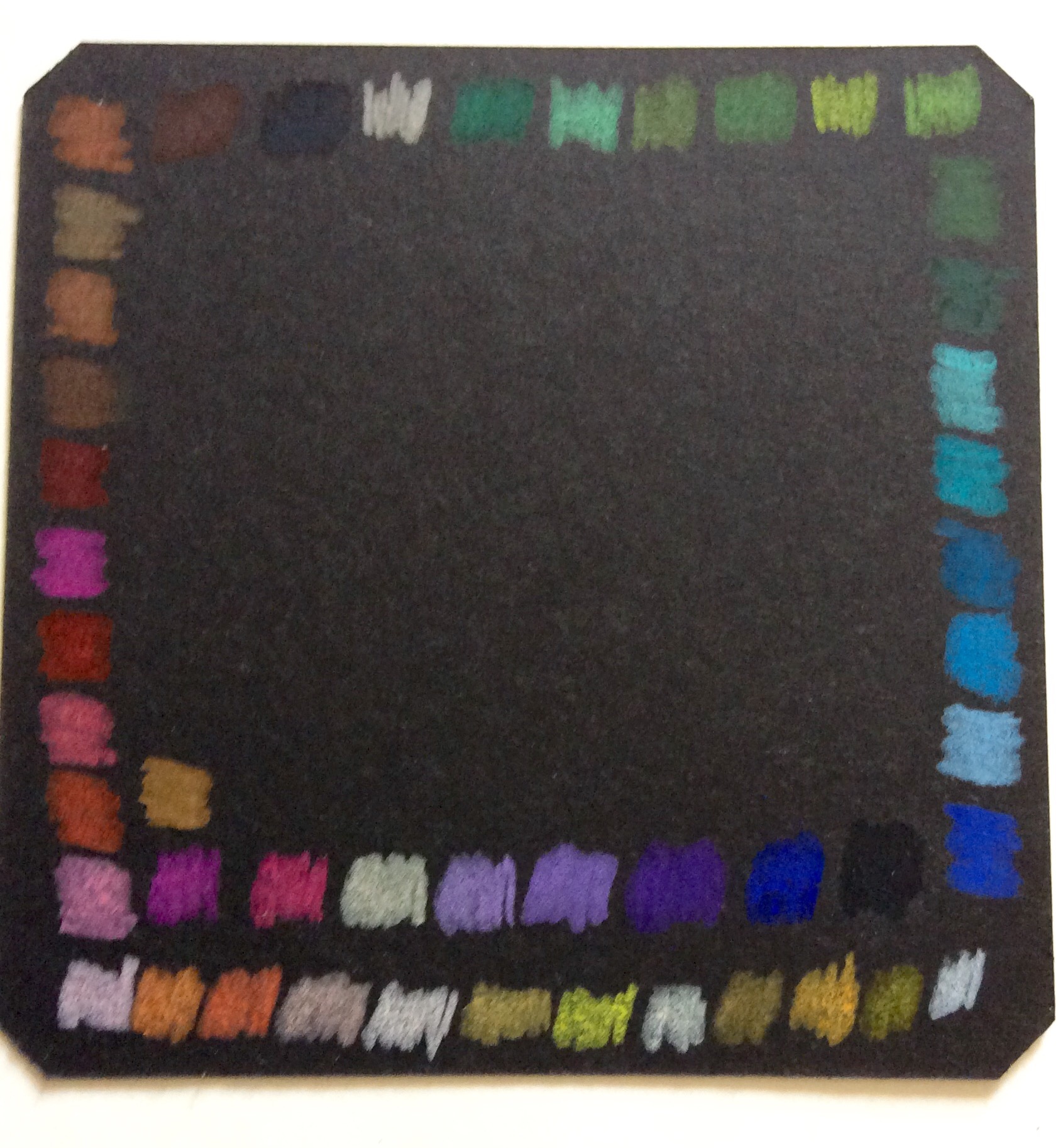
Because I have tons of color pencils, I decided to see how they look on black tiles. I took out my sets of 48 Prismacolor Premier, 36 Derwent Studio, and–because it was unfair to compare the professional quality Prismacolors to the student quality Derwents–my 24 Prismacolor Scholar. It was late, and I was not doing well judging placement, so the swatches of the Premier are small. But, except for a few almost invisible colors, they were vibrant and true. 

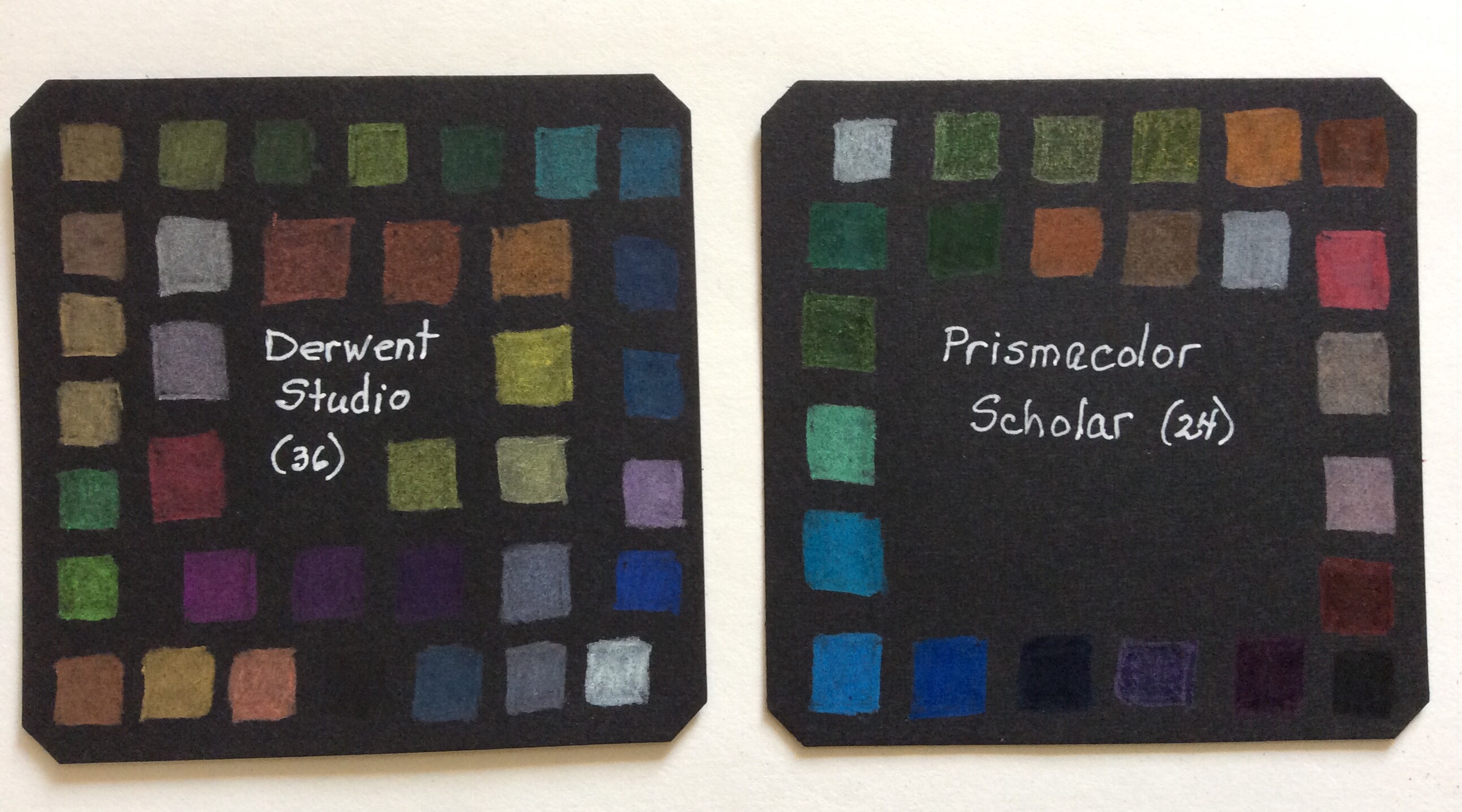
As I worked swatches of the Derwent Studio pencils, it was readily apparent that I had to press much harder and apply more layers to get close to the true colors. However, the end result looked pretty good on the black background. Just not as good as the Prismacolor Premier. I was expecting the Prismacolor Scholar colors to be just as wonderful as their professional counterparts. Well, see for yourself in the side-by-side tiles of the two student grade sets. 

Pressure and coats was about the same for both student quality sets. Some of the Scholar swatches are brighter than their Studio counterparts, but proportionately fewer Scholar colors are clear and visible compared to Studio colors. Overall, the Studio colors tend to be more subdued than either of the Prismacolor matches. However, I really did not like working with the Scholar pencils, mostly because they are so waxy that I felt as though I were coloring with birthday cake candles. As for the subdued Studio colors, sometimes that is the preferred effect for a piece. 

Clearly, the best color pencil choice of these three is Prismacolor Premier. Some of the advantages of the Premier pencils is that the points don’t wear down so quickly because they give better coverage the first time; they are less waxy than the Studio colors and much less waxy than the Scholar ones. So until I can figure out which gel pens work best on black tiles, my Zentangle color use will be limited to shading or large motifs that don’t need a super-fine point. 

Please let me know if you have found a gel pen–Sakura or otherwise–that shows up well on black tiles. I can’t afford to keep buying new varieties to experiment with on black paper background. Thank you!

Zentangle: One stroke at a time…

#educ_dr

Posted in Art, Creative process, Creativity, relaxation, Zentangle | Tagged , , , , , | Leave a comment

Disappointed…

I was so excited this evening. My husband said our courier service delivered tons of stuff. I knew some of it would be my Gelly Roll pens–the ones I would use on the black Zentangle tiles. I picked him up from work and ripped into the boxes and envelopes from Amazon while he went into the little shop to buy milk and a few other essentials. Yes! The pens had arrived–along with books on drawing and painting ocean scenes (I do live on a Caribbean island, after all; might as well learn to paint the sea and beaches!). 

As soon as we got home, he took the dog for a walk, then went to get a pizza for us. Meanwhile, I was pulling out my black tiles and opening the gel pen packages. 

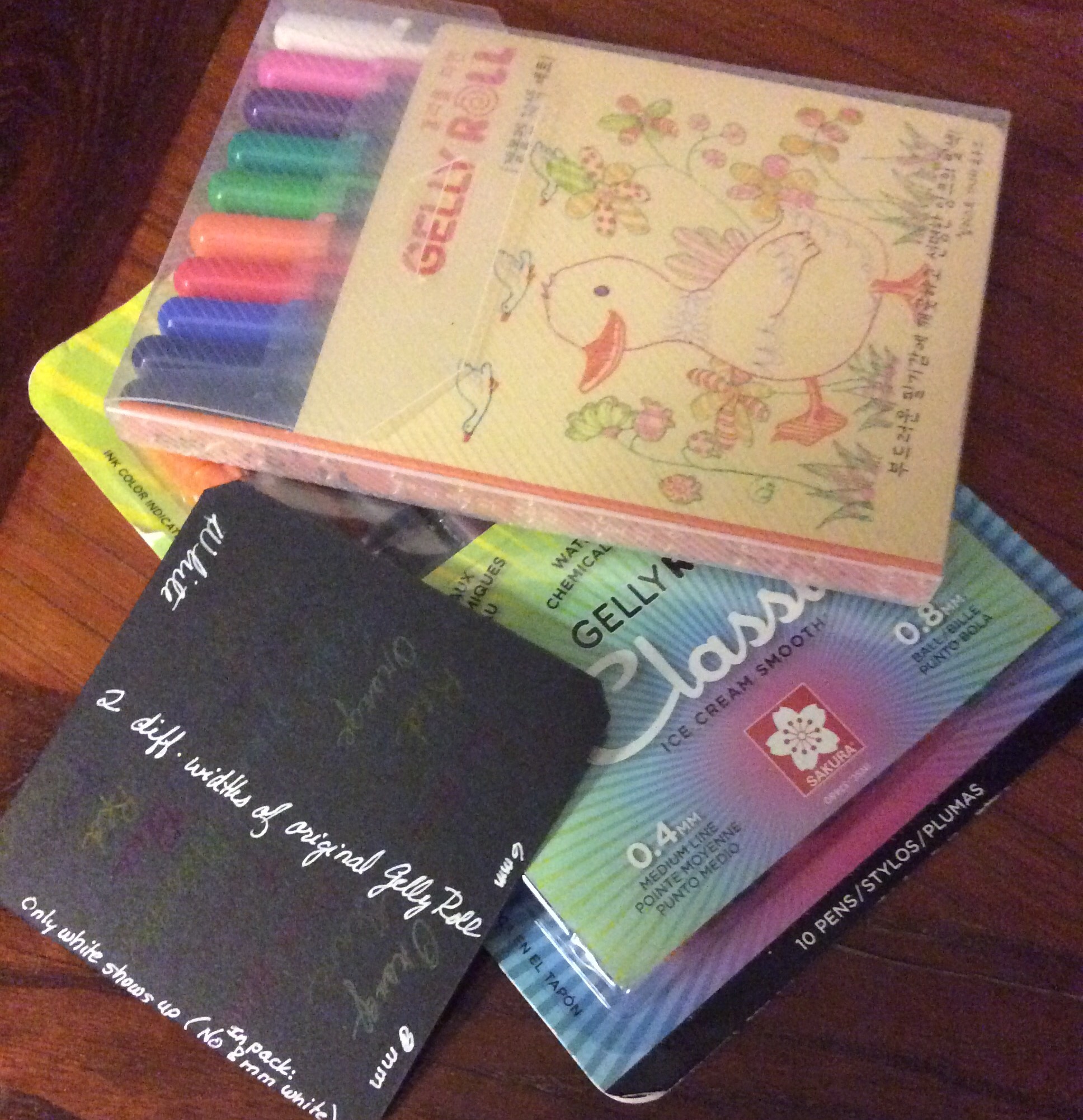
Hmm, I thought, as I tested the 6mm set of pens. I looked at the pen packages again. Yes. They were definitely Sakura Gelly Roll pens, with one of the boxes printed almost entirely in Japanese. I checked again for the manufacturer and brand name. Yep. Exactly what I ordered. And then I really felt let down. Here. Take a look.


The pens are vibrant, the inks are beautiful and true to color. So why was the only color clearly visible on the black tile from the single white pen? In the lamp light, you can see the ghosts of the other colors. I can understand browns, blacks, and dark blues–even the purples–not showing up. But why are red, rose/pink, grass green, lighter blue, and orange not showing up? 

When I went through this with the Gelly Roll Aqualip pens, I figured it was a fluke. You may have seen my Zentangle Influenced Art (ZIA) bird a few posts back. The bird was vibrant, and the Aqualip ink left an enamel-like appearance on the paper that can be seen better in person. I already knew those pens didn’t work on black tiles. When I ordered these, I thought I checked the descriptions to make certain the colors would remain true on black backgrounds. Instead, the colors disappeared into the tiles just like the Aqualip ones did. But then, sometimes on Amazon the same description is used without adjustments for product differences within brand. Maybe that’s what happened. With the Aqualip, I hadn’t been thinking about whether they would show up on black, as I hadn’t really planned on creating black tiles. But this latest purchase was both purposeful and dramatically disappointing. 

Does anyone know which of the Sakura–or any other brand of–pens shows up, and shows up true, on black paper tiles and other backgrounds? Do the Gelly Roll pens work better on another medium, such as gypsum board? Aside from some brands of color pencils, are other mediums better for black backgrounds–pastels, acrylic paint, acrylic inks? Perhaps opaque watercolors? Markers don’t work; I have tried those already.

Any help would be greatly appreciated. I will also try to research this problem myself, but I get the feeling I will get no answers completely on my own. Please help. 

Thank you!

Until next time…Keep on inking!

#educ_dr

Posted in Art, Creativity, Writing process, Zentangle | Tagged , , , , | Leave a comment

Reflected Shadow?

In art, we have all heard about reflected light–that indirect light that is reflected from the surfaces around the subject of a drawing or painting, but that is not part of the light source shining directly on the object. In literature, we have all head of foreshadowing, so that we get the idea that further into our reading something mysterious, or as yet unknown to us, will occur. In each case, there is some sort of defined phenomenon that, when we use our logic, should not yet be in evidence, or should not be–logically–in the picture. 

What I have learned in the past year or so (maybe also long ago, but who remember?) is that reflected light does exist in the world around us if we just take the time to notice it; and that foreshadowing is a device that can hold or restore our interest at a time that we were ready to abandon the book or story for something that moves along faster or whose prose is colorful enough to sustain continued reading. 

But why does the art world not speak of reflected shade? Why does literature not discuss “fore-enlightenment” or pre- enlightenment? Even the literary term presage has a negative connotation that typically leads to thoughts of danger or doom. The art world speaks of the quality and quantity of light in paintings or sketches, and may speak of general shading; but is there no such thing as reflected shade or shadow? Granted, I have not read a lot about art history or applied art, but I have heard and read about the use of shadow and light. As yet, I have not come across the term reflected shadow or reflected shade, although its existence is evident in Nature, and I can see the use of such a device in many works of art. 

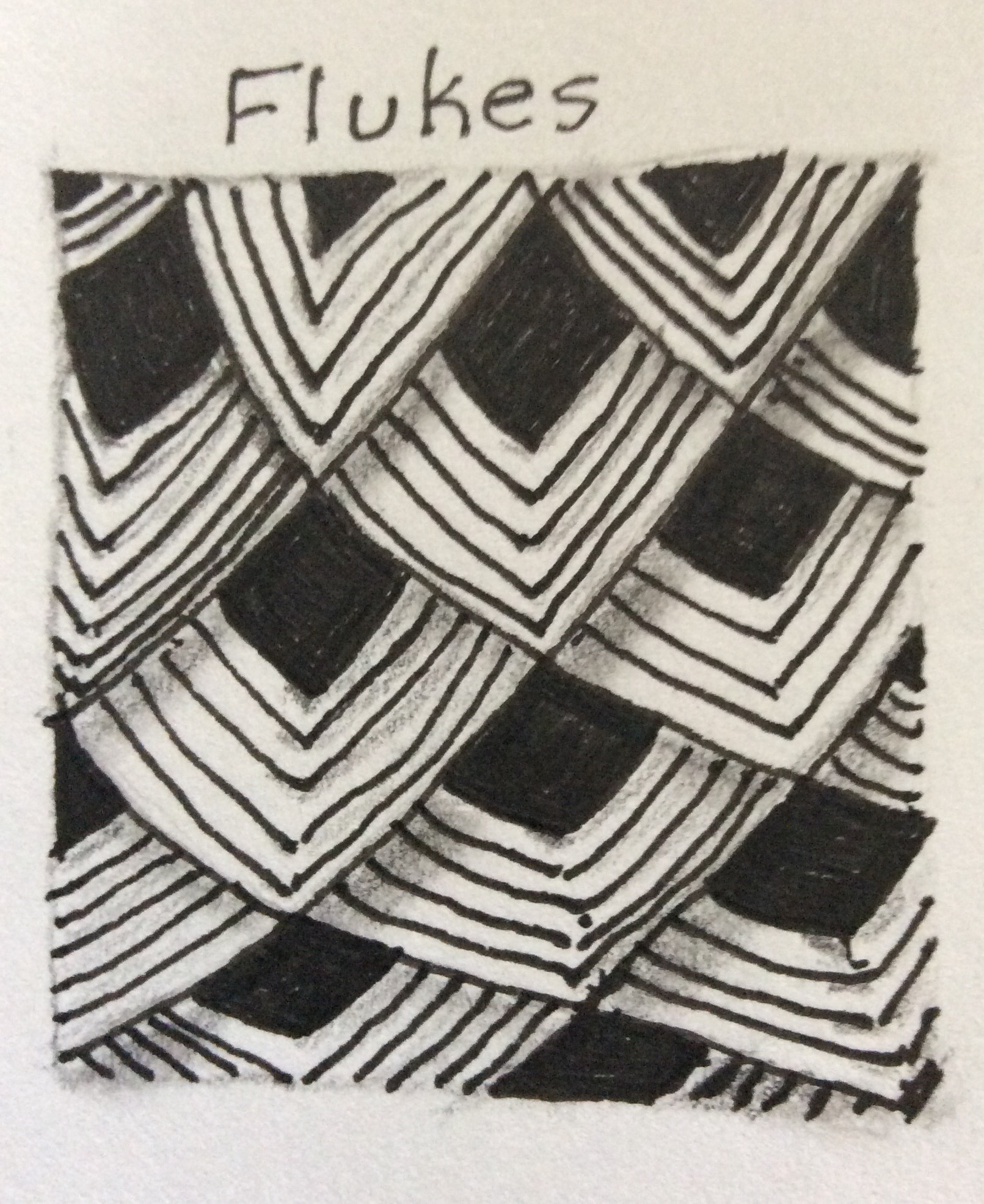
Why am I asking about reflected shadow? Well, as I was practicing the Zentangle pattern (more correctly, I suppose, called a tangle), it dawned on me that I could not just shade the Fluke tangle as recommended by the author of the book I am following, but that I need to use “reflected shadow” to give the piece greater dimension. This is not shadow or shade thrown by light shining directly at an object from a given angle; this is shadow that is picked up from objects or aspects of objects that are not put there by the light source. 

Keeping in mind that I am neither artist nor talented anything, note that I added a touch of shade where the light source should be shining, a shadow that seems an integral part of the “layers” I envision as the pattern is drawn. 
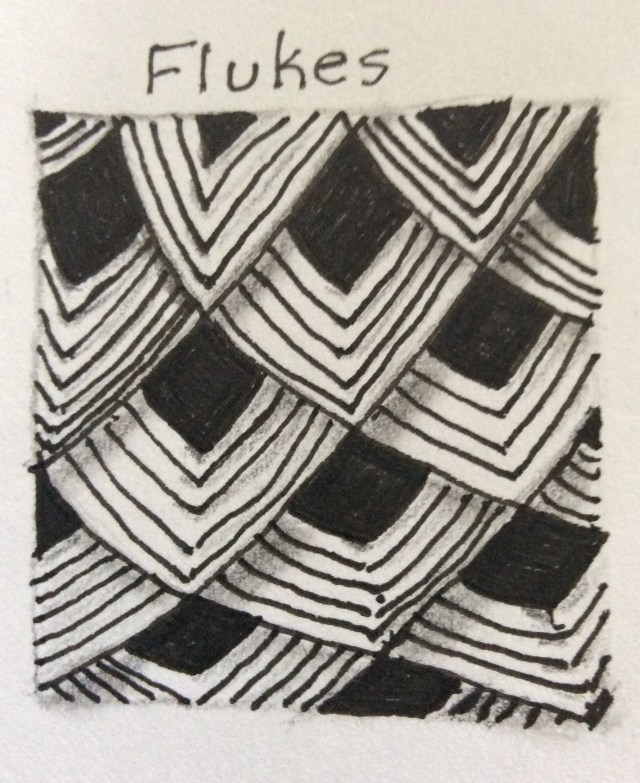
Notice that, in many cases, I have added a hint of shadow where the fine lines come together, and to the left of the tip of the filled-in square. I experimented with stacks of books and fanned papers to see how they appear when the light source should be spreading light under the “layers.” Instead of the absence of dark from the flowing light, there is what appears to be a reflection of the shadow “underneathe” the surface layer. Granted, this drawing is amateurish and in clear need of much practice; but I cannot escape the evidence of my experimentation, and feel compelled to add that reflected darkness to allow for a bit more dimensionality to my drawing. 

Despite my newness to art in general and Zentangle in particular, I find that I am beginning to add my own embellishments–ones that seem more reflective of the real world–than my beginner’s and intermediate art “how-to” books describe drawing and painting. Perhaps the artists writing these books have so strongly incorporated certain observations and techniques into themselves and their work that such topics become too obvious to discuss. 

An example of what I can only call entrenchment goes back to the days when I was a computer programmer who functioned as intermediary between the technical staff and the company managers and “users” of the final products. I would listen to the techs and would listen to the executives; then I would translate into language each group could understand that information the other group was attempting to convey. Maybe because I think in terms of pictures (my right-brain at work–see the post Bilateral Thinking) and then attempt to translate what I “see” into language (mostly left-brained work), well…maybe that was why I was reasonably successful as the go-between. I knew the language of both parties, and could speak in words and sentences comprehensible to all. It was years before I discovered this is a talent that not everyone has. So maybe the artists that write the art books are equally challenged in conveying information needed by the novice. 

On the subject of writing, I suppose “reflected shadowing” is done with clues in mysteries, or insight into the thinking process of any book’s character. The story teller might point out a person listening in the bushes, or blatantly state that there certain events are are coming or newly introduced portents are soon to occur to shed light on the plot or event (and I don’t mind telling you that I really dislike “little did she know that an attempt n her life would end this speculation” type of thing). It is easy enough to simply ignore or skip over such devices while reading. Obvious clues are so incorporated into a piece of good artwork that even the most jaded art critic might miss a point that would be invaluable when called to the attention of a novice artist. 

Probably someone, somewhere in the literature of art–whether paean, malicious critique, or helpful “how-to” book–someone has used and explained what I call reflected shadow. Surely I am not the first novice to have noticed that, in my ignorance of the massive literature and within the solace of my “how-to” books–I have missed any discussion of the opposite of reflected light: reflected shadow.

Keep light in your work, regardless how dark. Even a star on the horizon during a cloudy and moonless night gives us hope. 

#educ_dr

Posted in Art, Learning to Write, writing, Zentangle | Tagged , , , , , , , , , , , | Leave a comment

Bilateral Thinking

That is what I call this tile: Bilateral Thinking. Not sure why, except that there is almost a yin-yang effect, with one half more romanticized and the other more geometric and straight-forward. 

As was a previously posted tile, this Zenangle is done in white Jelly Roll pen and white sketch pencil. The patterns or motifs used are Crescent Moon, Flux, Jonqual, Fescue, Shattuck, and tangleations of Fescue and Flux. The pen fill-in strokes are more evident on this tile than even on the last, but I think the laceyness of the other patterns makes the pen movements and “skips” less obvious by comparison. 

To me, bilateral thinking is a necessary part of successfully and almost gracefully moving through life. I think it is far more encompassing and complete than either right-brained, highly creative thinking (or even “air-headed” thinking) or left-brained rational, logical, sometimes boring old straightforward thinking. What I am calling bilateral thinking draws from both sides of the brain in such a way that creativity is enhanced with one foot in Wonderland and the other solidly standing in the real world. 

As time goes on, I believe that scientists who study this stuff will find that the most inventive endeavors and best writing and art forms come from a balance of viewing the world from both sides and utilizing that balance to write the greatest books, produce the greatest art works, and invent the most useful tools and architecture. 

Think about it. How many times have you come up with a great story or piece of prose that falls flat because, although you were creative enough to come up with a great idea, the straightforward, logical part of your brain just couldn’t come up with the right story line. Or maybe you came up with the right sequence for your work, but couldn’t come up with the right blend or order of words to make your sequence come alive? The authors we love to read have both a straight and logical story line and a writing style that paints pictures and emotions in our minds.

Looking at the graphic ars, how many times have we seen brilliantly executed watercolors, oil paintings, etchings, etc., that have pleased the eye but left our souls empty of emotional content? And yet a truly masterful painting grips us not only with the precision or form that comes from “the left brain,” but also with the “right-brained” creative qualities of vibrancy of life, movement, and most of all emotion to which our hearts and souls react with such force that the term “understanding the subject” seems like a trite phrase that cannot begin to convey Truth or new world view the art work is showing us? 

In much the same way, the art of Zentangle opens us to a world of creativity based on balance, and challenges us to take a limited number of logical or straightforward motifs and combine them n such a way that they bare our souls. I am far from a place where I can achieve the true balance of yin and yang; am a far cry from using both my logical left-brained thinking and my creative right-brained thinking; am too new to art to control my instruments and to writing to create deep prose or an acceptable poem. But I continue to strive for both experience and balance to reach that sense of enlightenment. 

Until next time, keep each side of your brain open to the other’s ideas and suggestions. Try new things using logic and fantasy. Find your balance.

#educ_dr

Posted in About Writing, Art, Creativity, How to Write, writing, Zentangle | Tagged , , , , , , , | Leave a comment

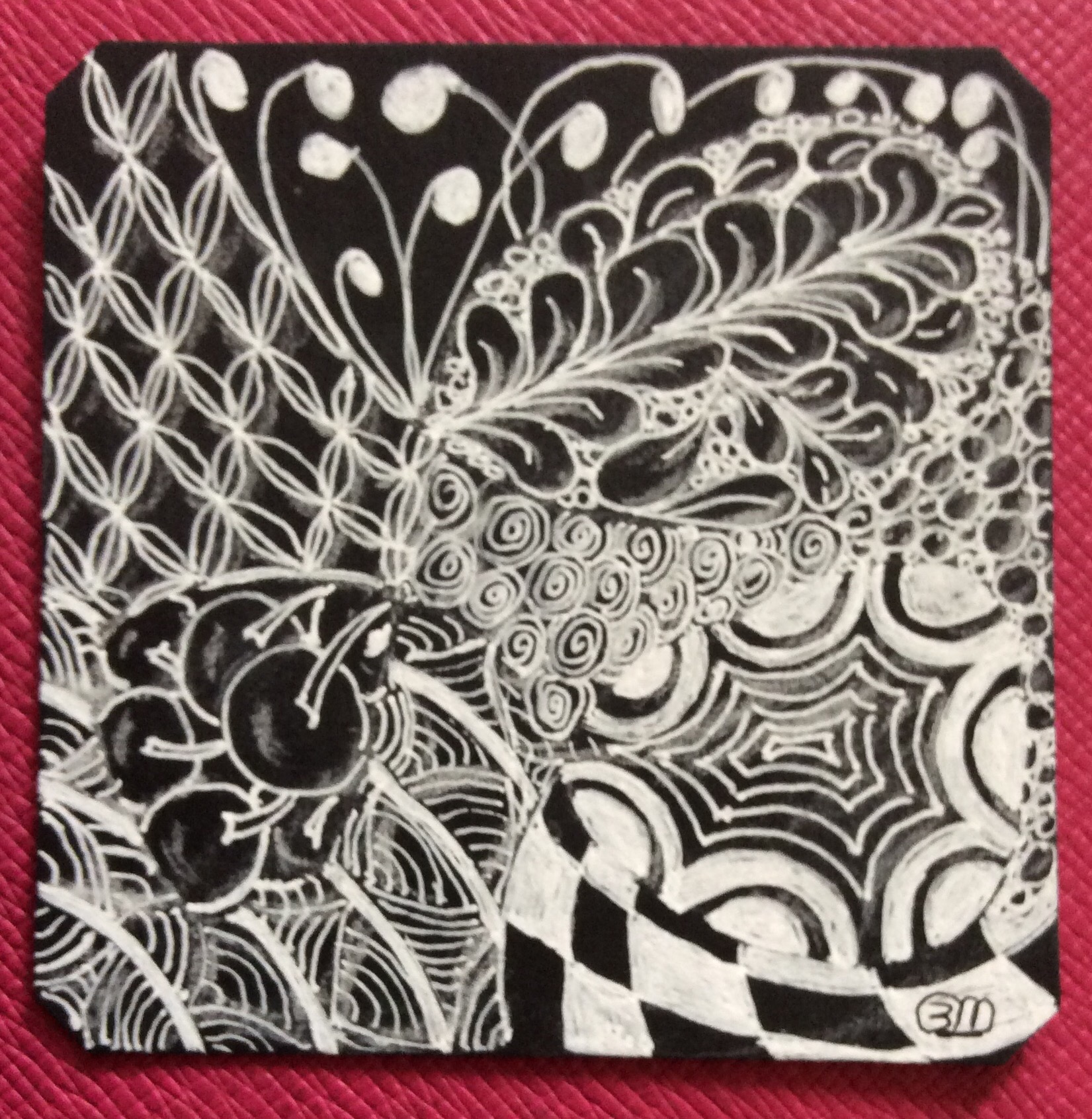
Black Tile Zentangle


Today, I completed my first Zentangle on a black tile. Clearly, I have a lot to learn. Although using the recommended Sakura Jelly Roll white pen and the recommended white sketch pencil for string construction and shading, the results are not what I expected. It is not the patterns or arrangement I used; it’s the combination of the white pen and pencil that I clearly need to practice with. I expected the white pen to flow better, and the white pencil to work better with the pen. 

In this close-up of my work, it is evident that the pen was used to color in the white areas. Almost each stroke stands out individually. Instead of a smooth colored in area like I get when using the Micron pen, any area I go over with the Jelly Roll mars the strokes that preceded the new stroke. The result is that the filled areas appear blotchy. I need both advice and practice on fill-in work using the white gel pen.

On top of that, my white sketch pencil refuses to sharpen up properly. Maybe I need a different pencil sharpener; or maybe I need a different sort of white pencil. Either way, although this pencil makes a great string, I can’t get it to shade the way a graphite pencil would work on white paper. There is a lack of smoothness to the movement of this pencil so that I am having trouble working with it correctly. I am sure it is me and not the medium. But it won’t hurt to try a different white sketch pencil brand. 

Lastly, the combined use of this pencil with the thick-ink pen does not give me the same type of shading control that the graphite pencil on the thinner Micron ink, even after accounting for the drag on the white pencil. Because of the thickness of the gel pen’s ink, shading with the white pencil seems to leave a “skip” when graphite shading techniques are used. I suspect that I need to play with the combination of gel ink and white pencil to get a feel of how to work them properly as a team. 

This particular tile looked great before I started shading with the white pencil–well, much better, anyway. I wish I had left it unshaded. It may have lacked some depth, but it looked better to my eye before the shading was applied. 

Just another thing to learn and practice….

‘Till next time!

#educ_dr

Posted in Writing process | Leave a comment

About Zentangle…

Last time, I talked about doing something new. Zentangle is both an art form and a meditation technique. I became a bit impertinent on the topic, but that was my frustration showing. The truth is that I have been rather erratic with my Zentangle practice, and have been frustrated not with the steps and patterns, but with my jittery hand. I guess tremor is not unusual at my age, but it frustrates me to no end when a twitch spoils my “art”–whether graphic or verbal. That is why I feel most comfortable drawing with pencil or working with oil paint. Both are easily fixed with eraser or white spirit, respectively. But working with ink is a whole other matter.


Zentangle, in its finished form, is ideally done on a tile that is 3.5″ square. It is worked in black ink and shaded with graphite pencil. At least, that is how it is initially taught. I practice in my sketch book, usually in pencil because I forget to switch to ink once I have drawn my “string.” A string is a means of blocking out a tile to take different designs in each cell created by the string or strings crossing each other. The example above, comprised of 18 cells, looks like it should be a finished product, but it is in my sketchbook, not on a tile. This is because I lacked the self-confidence to commit my work to a tile. Tiles, although basically nothing more than small blocks of watercolor quality paper, are not inexpensive. Since I am reluctant to waste money, I work a lot in my sketch pad. The problem is that each Zentangle is a unique product of the moment in which it is created. Attempts to replicate lead to frustration as The Moment is no longer conducive to the same Zentangle. 

Another source of frustration is when I begin a Zentangle on a tile, but forget to switch to ink after I draw my string. The result is a nice study that is less permanent than the paper it is drawn on. Some people do just fine tracing over their work accurately. Not I. I might as well start from scratch than trace over pencil in ink. Besides, ink does not do well over filled in areas of graphite, and erasure changes the texture of the paper. With pencil, the contrasts are far less dramatic. I end up with something like this early tile.


Imagine if the dark areas were black instead of graphite gray. Not at all the same effect. 

Despite frustrations, I continue to enjoy Zentangle as both an art form and a means to relaxation. I sometimes start my tangle in the wrong frame of mind and, despite deep breathing and all the other relaxation techniques I try, the resulting piece is pretty bad.

What I need to do is be easier on myself. I need to let myself go and allow the art to happen. It doesn’t matter whether I am working with drawings or words; I need to allow myself to fail with grace. Each failure should come with more of a lesson than being frustrated with my inner self or my body’s decline. I need to analyze the moment and see if there are changes I can make to the environment–physical or mental–that would allow me to create more effectively. It may be that I determine that the timing just wasn’t right for my attempt. Sometimes, not a single change would have resulted in a better outcome; sometimes, shit happens. 

#educ_dr

Posted in About Writing, Art, Creative process, Creativity, relaxation, Zentangle | Tagged , , , , , | 3 Comments

Trying New Things


This is a means of communication. No words, no great creativity. But I got some new toys and wanted to share the joy of something new. Oh, and to figure out what this doodle might be communicating. 

For several weeks, I have been playing with Zentangle. I began with the very basic tools: ultra fine black Micron pen, a 2B pencil, a sketchbook, and some 3.5″ square art tiles (a pack of white and one of black), and a book (One Zentangle a Day, by Beckah Krahula). It wasn’t like I needed yet one more art form to be a complete beginner at doing; I got sucked in by the meditation process that is supposed to go along with it. The whole idea is to be able to get oneself into a relaxed frame of mind and allow the Zentangle process allow one to focus and, ultimately, relax while the Zentangle sort of happens.

Now, relaxation is supposed to stimulate creativity, and I guess the creativity stimulates release of tension. Frankly, although I have created some lovely designs as I learn the individual tangles, the completed piece–whether in my practice sketchbook or on a tile–looks (to me) like nothing more than a doodle, the stuff I used to draw in class or boring business meetings. And, although there are supposed to be something like 115 “genuine Zentangle” basic doodles, I have found not a single book that has them all. And I just don’t have the energy to search out all the sanctioned designs. And really. Why, authors of books X, Y, and Z, do you show me how to do variations on a theme if you are going to withhold more than half of the designs in the art form, and you are not writing another book??? Don’t you know I have no patience? Ah. That’s one of the points of this process, isn’t it?

So This Impatient Novice “Artist” switched to Zentangle Inspired Art (ZIA) as my beginning tool. For a short while. What you see is my first attempt at using tangles that I know in order to create something a bit different in freehand and without “strings,” using new toys that I picked up locally or through Amazon. The tangles used here are Flux, Nekton, Tipple, Crescent Moon, Shattuck, a single Printemps, a tangleation of Poke Root, Amaze, and Tagh, along with some impromptu embellishments. Also, there is a tangleation of Flux here. A tangleation is a modification or embellishment of a basic tangle. I have learned more tangles, but I either have a hard time with them, or I just don’t like them. And there are so many more to learn…

So what am I communicating with this? First, I am taking a stab at independence from the rigidity of following one book–well, maybe more than one (they all seem to follow the same methodology if not the same order of tangles)–to get me started. Second, I am communicating my lack of knowledge about combining colors that work well together. Maybe that is why they start you out with a black pen and a graphite pencil. The colors may be because I really want to practice with all the new toys at my disposal at once. Third, I am communicating that this art form has taught me more about shading and shadow than I can observe, read about, or guess on my own. It seems no matter how many workshops I attend or books on technique I read, shadow and shade became sensible when following authors’ instructions for shading the tangles. 

Needless to say, just as I keep practicing writing skills and oil painting and sketching skills, so I will also continue to learn and practice new Zentangle forms and stray from the structured path to do new (and hopefully better) doodles. After all, every new thing I learn applies to so many aspects of my life. And I am nothing if not a life-long learner. 

Will I ever learn the art of patience? Who knows. I am having fun!

Write on! Or create on!
#educ_dr

Posted in About Writing, Creativity, improving my writing, Something New | Tagged , , , , , , , , , | 6 Comments

The Art of Story Telling… 

Recently, I have read several novels in which the art of the story teller–oral storytelling–was celebrated. As most people do, I love to hear a good story told. Or perhaps even a bad story told in an interesting, mesmerizing, or dramatic way–one that snags the listener and holds him or her captive to the end. 

Great story telling is an art form. It involves the use of the teller’s voice, words, plan of sequence, cadence, body language, ability to live the story, acting ability, and many nuances of voice, body, and mind that I cannot even begin to put into words. A great story teller paints an image and adds ambiance that puts the listener not only into the story, but into the very setting in which the story takes place. The listener becomes a participant–or at very least a passionate and involved on-the-scene observer–of all that is taking place. 

So much of such story telling ability is involved in good writing, as well. Think back to the books you have read that remain in your mind or as part of your life for years and years after you finished reading the last page. The book may have ended, but the subject and environment of the book remain as part of you, as though you had been part of the experience. The story becomes part of your own memory of personal or observed experiences. Such is the mark of a truly great book. 

As the great story teller is a rarity in contemporary society, so is the great writer. Many of us write, and consider ourselves great writers. But so few of us have a following of readers who are mesmerized by what we put to paper or screen. Most of us write for the pleasure of seeing our words in print, and maybe with a story that we think is particularly clever. Blogging is a great means by which to get ourselves–our little works of art–out and about to faithful or fitfull readers (assuming we have a readership beyond family and close friends). Is the reason we are relatively obscure because we don’t have the talent to tell a really great story? Or is it because we do not have a following of readers–we have not put ourselves out there or out far enough? Or have we not adequately set the scene, with fragrances and background sounds, with the right ambiance, or a word painting of the place and time? Have we missed something in our description? Have we inadvertently changed our tone? Did we fail to note how the setting makes us feel? 

I don’t have the answer to this. My writing is mediocre and mundane. I write because I enjoy seeing my words and ideas on paper or device screen, whether anyone else reads my words or not. I don’t have the talent of a great and gifted story teller. But I can certainly learn from the masters and polish my words and style to become better. What I share is practice, just like the beginning student art work I sometimes share. Silently, I am asking you: Have I improved? Is this piece something you will remember or identify with? Is my style so prosaic as to be unworthy of the space it takes up? Do you think I will get better? or worse?? Might my future posts be worth a read? 

Or maybe I am asking: Do you like me? 

If only I had the time to practice more, and more often…

##

#educ_dr

Posted in Writing process | 2 Comments

“Fahrenheit 451” 60 Years Later: “Why do we need the things in books?”

plthomasedd's avatardr. p.l. (paul) thomas

“Sometimes writers write about a world that does not yet exist,” Neil Gaiman begins his Introduction to the 60th Anniversary Edition of Ray Bradbury’s Fahrenheit 451:

This is a book of warning. It is a reminder that what we have is valuable, and that sometimes we take what we value for granted….

People think—wrongly—that speculative fiction is about predicting the future, but it isn’t; or if it is, it tends to do a rotten job of it….

What speculative fiction is really good at is not the future but the present—taking an aspect of it that troubles or is dangerous, and extending and extrapolating that aspect into something that allows the people of that time to see what they are doing from a different angle and from a different place. It’s cautionary.

Fahrenheit 451 is speculative fiction. It’s an “If this goes on…” story. Ray Bradbury was writing about…

View original post 1,182 more words

Posted in Writing process | 6 Comments

Independent Publishers – Outsource Your Marketing to Save Yourself Time

Are you serious about e-publishing your article or book? You will want a “marketing guy” (or gal) to get you noticed. And you want to exchange information with other writers/bloggers. Get som great tops from Don, starting with the link below.


Source: Independent Publishers – Outsource Your Marketing to Save Yourself Time


#edic_dr

Posted in Writing process | Comments Off on Independent Publishers – Outsource Your Marketing to Save Yourself Time